


 ENG
ENG 中文简体
中文简体 русский
 عربى
عربىContent
- 1 Quick Answer: What Matters Most When Choosing a Biodegradable Plastic Modification Production Line
- 2 What a Biodegradable Plastic Modification Production Line Actually Includes
- 3 Matching Biodegradable Plastic Processing Equipment to Your Material Mix
- 4 Screw Diameter and Torque: Reading the Specifications That Matter
- 5 Production Capacity Planning Across Factory Scales
- 6 Rising Demand Behind Investment in Biodegradable Plastic Modification Production Lines
- 7 Customized Formulas: Starch, Bamboo and Wood Powder, and Mineral Filling
- 8 Comparing Production Line Configurations for Different Applications
- 9 Common Pitfalls When Specifying Biodegradable Plastic Processing Equipment
- 10 Automation and Control Systems for Consistent Output Quality
- 11 A Step by Step Approach to Selecting Your Production Line
- 12 Manufacturing Capability Behind This Guide
- 13 Biodegradable Plastic Modification Production Line FAQ
- 13.1 Q1: What is a biodegradable plastic modification production line
- 13.2 Q2: What biodegradable materials can be modified by this production line
- 13.3 Q3: What is the production capacity of a biodegradable plastic compounding line
- 13.4 Q4: What equipment is included in a biodegradable plastic modification production line
- 13.5 Q5: Can biodegradable plastic production lines customize formulas
- 13.6 Q6: What is the difference between biodegradable plastic modification and plastic recycling modification
- 13.7 Q7: How does a twin screw extruder improve biodegradable plastic quality
Quick Answer: What Matters Most When Choosing a Biodegradable Plastic Modification Production Line
The right biodegradable plastic modification production line is the one that matches your material mix, your target output, and your automation needs at the same time. Before any equipment specification is finalized, five checkpoints deserve attention: material compatibility, twin screw extruder torque and screw configuration, production capacity, control system sophistication, and formula flexibility for tasks such as starch filling or mineral powder filling modification. A line built around solid biodegradable plastic processing equipment that skips any one of these checkpoints tends to underperform once it moves from a demonstration run into daily manufacturing.
Five Checkpoints Before You Commit to a Production Line
- Material compatibility: confirm the line can handle PLA, PBAT, PBS, PHA, starch-based polymers, or blends of these resins without frequent screw or die changes.
- Torque and screw configuration: higher specific torque supports better filler dispersion for bamboo powder, wood powder, or mineral powder filling.
- Production capacity: match screw diameter and line design to your target output range rather than buying oversized or undersized equipment.
- Control system depth: recipe management, feeding accuracy, and melt temperature monitoring keep batches consistent over long runs.
- Formula flexibility: a custom biodegradable plastic production line should accept formula changes without major hardware rework.
What a Biodegradable Plastic Modification Production Line Actually Includes
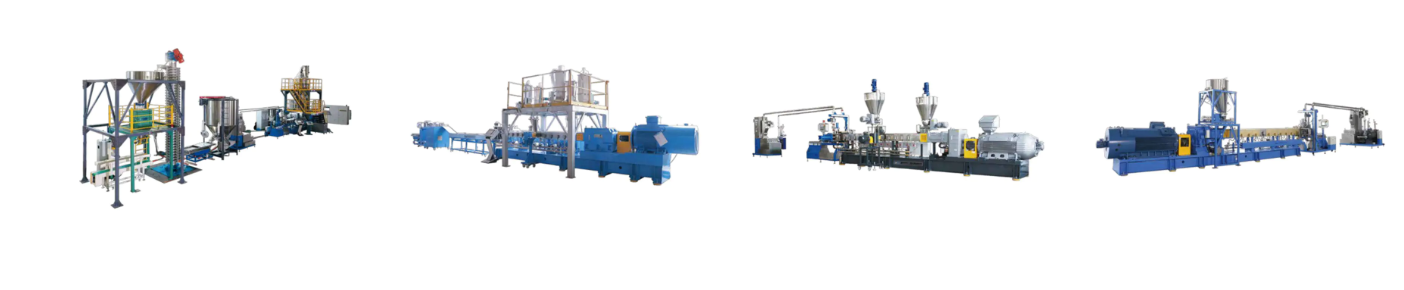
A modification production line is not a single machine but an integrated system that carries resin and filler from raw material intake through to finished pellets. Typical applications include alloy blending of fully degradable resins such as PLA, PBAT, PBS, PPC, PCL, TPS, and PHA, along with starch filling modification, bamboo and wood powder filling modification, and mineral powder filling modification. Understanding how each subsystem contributes to the finished compound helps a factory evaluate biodegradable plastic processing equipment on more than just headline specifications.
These subsystems do not operate independently. A feeding system that meters filler slightly off ratio places extra strain on the twin screw extruder, which then affects melt temperature, which in turn changes how the pelletizing system cuts the strand. Reviewing a biodegradable plastic modification production line as one connected process, rather than five separate machines, makes it easier to spot where a bottleneck is likely to appear once real production volumes begin.
| Subsystem | Primary Function | Why It Matters |
|---|---|---|
| Feeding System | Meters resin, filler, and additives into the extruder at a set ratio | Feeding accuracy directly controls formula consistency batch to batch |
| Twin Screw Extruder | Melts, mixes, and shears the material along the screw profile | Screw design and torque determine dispersion quality and output rate |
| Pelletizing System | Cuts the extruded strand or underwater melt into uniform pellets | Pellet shape and size uniformity affect downstream processing |
| Cooling System | Solidifies the compound before or during pelletizing | Proper cooling prevents pellet clumping and preserves material properties |
| Control System | Coordinates feeding rate, screw speed, temperature zones, and data logging | Central to repeatable quality across long production runs |
Matching Biodegradable Plastic Processing Equipment to Your Material Mix
PLA, PBAT, PBS, PHA, and starch-based polymers do not behave the same way inside an extruder. PLA tends to be sensitive to residual moisture and benefits from careful melt temperature control to preserve mechanical strength. PBAT usually calls for higher torque to disperse fillers evenly and often pairs with PLA in a PLA PBAT compounding production line to balance flexibility with rigidity. Starch-based formulas bring strong moisture sensitivity and often need higher filler compatibility for bamboo, wood, or mineral powder loading. PBS behaves closer to PBAT in torque demand but with somewhat lower cooling requirements, while PHA formulations tend to need gentler shear to avoid degrading the polymer chain during melt processing.
How PLA, PBAT and Starch-Based Formulas Compare in Processing Behavior
Figure: relative processing profile comparison for PLA, PBAT and starch-based formulas across five compounding parameters, shown on an illustrative scale of one to five.
PBS and PHA are not charted above to keep the comparison readable, but both remain common choices for a biodegradable polymer modification equipment setup, particularly when a factory blends several resins to balance cost, flexibility, and compostability targets.
Drying and Moisture Handling Before Extrusion
Because PLA and starch-based polymers absorb ambient moisture readily, many factories pair the compounding line with a dedicated drying hopper ahead of the feeding system. Skipping this step, or drying at an inconsistent rate, tends to show up later as inconsistent melt strength or visible bubbles in the pelletized output, which is one reason moisture handling deserves the same attention as torque and screw speed during equipment planning.
Screw Diameter and Torque: Reading the Specifications That Matter
Specific torque, usually expressed in Newton meters per cubic centimeter, is one of the more telling numbers on a twin screw extruder data sheet. A twin screw extruder for PLA modification with higher specific torque can push more material through the same screw diameter without sacrificing mixing quality, which becomes especially important when adding rigid fillers to PBAT or starch-based formulas. Screw diameter ranges commonly span from small laboratory sizes near 8 millimeters up to heavy industrial sizes above 150 millimeters, and each class of extruder plays a different role inside a factory's overall equipment plan.
Typical Screw Diameter Classes and Relative Processing Capacity
Figure: relative processing capacity levels by screw diameter class, shown as a comparative index rather than fixed output figures, since actual throughput depends on formulation and screw profile.
A well-designed biodegradable plastic compounding machine manufacturer will usually offer several screw diameter options within one product family, so a factory can move from pilot testing to full production without switching equipment platforms entirely.
Screw Element Layout and Kneading Block Placement
Beyond raw torque, the arrangement of conveying elements and kneading blocks along the screw length shapes how well a formula mixes. A screw profile built for lightly filled PLA blends usually places kneading sections earlier, while a profile tuned for heavily filled PBAT or starch-based compounds often needs additional kneading zones further down the barrel to fully disperse bamboo, wood, or mineral powder without overheating the melt. This is one reason two extruders with identical screw diameter can still produce noticeably different pellet quality on the same formula.
Production Capacity Planning Across Factory Scales
Biodegradable plastic production capacity generally rises with screw diameter, but it also depends on formulation viscosity, filler loading, and downstream pelletizing setup. Planning capacity around realistic order volumes, rather than around the largest available extruder, keeps energy use and floor space proportional to actual output needs. This is particularly relevant for an industrial biodegradable plastic pelletizing line that will run continuously across multiple shifts.
Figure: illustrative production capacity ranges for common biodegradable plastic modification production line scales, typical for twin screw compounding equipment.
Real world throughput on any given line shifts with filler content, target pellet size, and how much drying or cooling time the formula needs before it can be packed. A heavily filled starch-based compound, for example, may run somewhat slower than a lightly filled PLA blend on the same extruder, simply because the higher solids content changes melt viscosity and cooling behavior. Building in a reasonable margin between rated capacity and planned daily output helps absorb these formula-to-formula differences without constant line adjustment.
Rising Demand Behind Investment in Biodegradable Plastic Modification Production Lines
Several independent industry outlooks published through 2026 point to sustained double digit growth for biodegradable and bio based plastics, with packaging remaining the largest application and PLA, PBAT, and starch based materials cited most often as the fastest growing product types. That broader demand trend is one reason more factories are evaluating a biodegradable plastic extrusion machine supplier earlier in their expansion planning rather than treating compounding equipment as an afterthought.
Figure: illustrative index of rising demand for biodegradable plastic processing equipment, reflecting the general upward direction reported across recent industry market outlooks, with the base year 2021 set at 100.
For a factory sizing new equipment today, the practical takeaway is less about hitting an exact growth number and more about building in room to expand. Choosing a production line with a screw and control platform that can accept a slightly larger feeding module or an additional pelletizing head later on tends to be more useful than trying to guess a final order volume years in advance.
Customized Formulas: Starch, Bamboo and Wood Powder, and Mineral Filling
Custom biodegradable plastic compounding is common practice rather than an exception, since packaging, agriculture, and molded goods each call for a different balance of flexibility, stiffness, and cost. A production line that supports formula changes without major hardware rework gives a factory room to respond to new orders quickly.
- Starch filling modification: lowers raw material cost while maintaining reasonable flexibility for bag and film applications.
- Bamboo and wood powder filling modification: adds a natural fiber feel and stiffness, often used in rigid tableware and molded items.
- Mineral powder filling modification: improves dimensional stability and can help balance shrinkage in molded parts.
- Alloy blending: combining PLA with PBAT, or PBS with PPC, adjusts flexibility, heat resistance, and compostability behavior in a single pass.
Comparing Production Line Configurations for Different Applications
Not every factory needs the same equipment emphasis. A custom biodegradable plastic production line for flexible packaging looks different from one built for rigid molded goods, mainly in screw profile, filler handling, and pelletizing style.
| Application | Typical Base Resins | Key Equipment Emphasis |
|---|---|---|
| Flexible Packaging Film | PBAT, PLA blends, starch-based | Even melt strength, gentle shear, precise cooling |
| Injection Molded Compounds | PLA, PHA, mineral filled blends | Higher torque for filler dispersion, strand pelletizing |
| Agricultural Mulch Film | PBAT, PBS, starch-based | Consistent feeding accuracy for thin film uniformity |
| Rigid Tableware and Foam | PLA, bamboo or wood powder filled blends | Strong torque, underwater pelletizing, stable cooling |
In practice, many factories end up needing more than one configuration on the same line as their product mix grows, which is why formula flexibility was listed among the first checkpoints in this guide. A line that was originally sized for flexible packaging film can often take on light injection molding compound work later, provided the torque and pelletizing setup were specified with some headroom from the start.
Common Pitfalls When Specifying Biodegradable Plastic Processing Equipment
A number of avoidable mistakes show up repeatedly when factories first move from concept to installed equipment. Recognizing them early tends to save far more time than correcting them after commissioning.
- Sizing for volume that has not materialized yet: an oversized industrial line running well under its rated capacity often costs more to operate per kilogram than a right-sized line.
- Underestimating moisture control: treating drying as optional for PLA or starch-based formulas usually shows up later as inconsistent pellet quality.
- Choosing torque based on the lightest formula only: a line that struggles once bamboo, wood, or mineral powder filling is added will limit future formula changes.
- Skipping automation to simplify the initial purchase: manual recipe entry tends to introduce more batch to batch variation than a properly configured control system.
- Overlooking formula flexibility: a line built around one narrow formula can be difficult to adapt when a customer requests a different resin blend.
Automation and Control Systems for Consistent Output Quality
The control system is often the least visible part of a production line and one of the most important. Recipe management stores feeding ratios so operators do not need to reset parameters manually for every job change. Melt temperature monitoring and torque load tracking flag process drift before it produces off-spec pellets. Together, these functions support the kind of repeatable output that separates dependable biodegradable polymer modification equipment from equipment that only performs well during a demonstration run.
Why Control System Depth Affects Batch Consistency
Screw speed synchronization with feeding rate keeps the specific energy input stable, which matters for moisture sensitive resins like PLA and starch-based blends. Data logging across shifts also helps a quality team trace a batch back to its process conditions if a downstream customer reports an issue with film clarity or tensile strength.
Routine Monitoring That Supports Long Production Runs
Beyond the initial setup, a control system that tracks screw wear indirectly through torque trends over time gives maintenance staff a heads up before a worn element starts affecting mixing quality. Alarm thresholds on melt pressure and temperature also help operators catch a partial die blockage or a feeding hopper bridging issue early, before it turns into a longer unplanned stop.
A Step by Step Approach to Selecting Your Production Line
- Define your target output range in kilograms per hour based on realistic order volume, not maximum theoretical demand.
- Confirm your resin and filler mix, including whether starch, bamboo, wood, or mineral powder filling will be part of the formula.
- Evaluate specific torque and screw diameter needs against your heaviest filler loading scenario.
- Assess how much recipe automation and data logging your quality team requires.
- Plan factory layout, utility connections, and cooling water capacity around the chosen line size.
- Discuss your formulation goals directly with a biodegradable plastic compounding machine manufacturer before finalizing equipment specifications.
Manufacturing Capability Behind This Guide
Sichuan Kunwei Langsheng Extrusion Intelligent Equipment Co., Ltd. operates its headquarters and production base in Dujiangyan, Chengdu, Sichuan, with additional offices in Changzhou, Jiangsu, Dongguan, Guangdong, and Yuyao, Zhejiang, covering domestic chemical, pharmaceutical, and blending modification customers with sales and after sales support. As a biodegradable plastic modification production line manufacturer and biodegradable plastic extrusion machine supplier, the company brings together chemical machinery and electrical engineers with more than ten years of focused industry experience.
The main product line centers on high torque twin screw extruders, supported by deep experience across pharmaceutical processing equipment, chemical equipment, and blending modification, along with complete line design services for the modification industry. Screw diameter coverage spans from 8 millimeters up to 177 millimeters, and the equipment platform is engineered for a specific torque up to 14 Newton meters per cubic centimeter, giving factories a wide range of options when planning a biodegradable plastic processing equipment layout for alloy blending, starch filling, or mineral powder filling modification.
That experience spans three closely related fields: pharmaceutical and medicine processing equipment, chemical equipment, and blending modification, supported by a complete line matching group and full line design services for the modification industry. For a factory comparing a PBAT biodegradable plastic processing equipment supplier against several options, having one team handle screw design, feeding integration, and control system configuration together tends to simplify the overall planning process.
Biodegradable Plastic Modification Production Line FAQ
-
Q1: What is a biodegradable plastic modification production line
It is an integrated set of processing equipment, usually anchored by a twin screw extruder, that blends biodegradable resins such as PLA, PBAT, PBS, PHA, or starch-based polymers with fillers to create a compound resin ready for downstream film, sheet, injection, or tableware production.
-
Q2: What biodegradable materials can be modified by this production line
A well configured line can process PLA, PBAT, PBS, PHA, and starch-based polymers, either individually or blended together, along with fillers such as bamboo powder, wood powder, or mineral powder.
-
Q3: What is the production capacity of a biodegradable plastic compounding line
Biodegradable plastic production capacity generally scales with extruder screw diameter, ranging from small lab and pilot lines up to heavy duty industrial lines built for continuous compounding. Actual capacity depends on formulation and screw design.
-
Q4: What equipment is included in a biodegradable plastic modification production line
Core equipment typically includes a feeding system, a twin screw extruder, a pelletizing system, a cooling system, and a control system, working together to produce uniform compound pellets.
-
Q5: Can biodegradable plastic production lines customize formulas
Yes. Customized biodegradable plastic compounding is common, since factories often adjust resin ratios, filler types, and additive levels. A flexible line supports formula changes without major hardware modification.
-
Q6: What is the difference between biodegradable plastic modification and plastic recycling modification
Biodegradable plastic modification focuses on blending and reinforcing compostable or bio based resins, while plastic recycling modification generally focuses on restoring properties in recovered conventional plastics. Feeding and filtration needs often differ between the two.
-
Q7: How does a twin screw extruder improve biodegradable plastic quality
A twin screw extruder for PLA modification and similar biodegradable resins improves quality through better melt mixing, more uniform filler dispersion, and controlled shear, which helps maintain mechanical strength and consistency across production batches.


