


 ENG
 中文简体
 русский
 عربى
A glass-filled PA66 part that cracks in a drop test usually gets blamed on the moulding cell. Trace it back three weeks and the batch was cut from a compound whose glass bundles never fully opened, or whose moisture sat at 0.25% instead of 0.10%. Engineered polymer compounds are decided long before the injection unit - in formulation, feeding, melt mixing and pellet finishing.
The short version: a compound data sheet is a ceiling, not a promise. What reaches the press is the output of a process chain in which every step carries a tolerance, and the widest tolerance wins. The walk-through below follows that chain from the additive silo to the sieve.
Content
- 1 What Engineered Polymer Compounds Actually Are
- 2 Four Formulation Levers, and What Each One Costs
- 3 Dispersion, Not Loading, Decides Whether the Compound Works
- 4 Feeding Accuracy Sets the Real Tolerance Band
- 5 Cutting, Cooling and Drying: Where Money Leaks Out
- 6 Quality Gates Worth Writing Into the Purchase Order
- 7 Five Questions to Ask Before You Compare Prices
- 8 Engineered Polymer Compounds: Frequently Asked Questions
What Engineered Polymer Compounds Actually Are
An engineering polymer is a resin family - PA6, PA66, PBT, POM, PC, PPS, PPA - selected for a temperature ceiling, a strength floor or a chemical resistance requirement. A compound is that resin after reinforcement, fillers, impact modifiers, flame retardants and stabilisers have been melt-mixed into it and cut into pellets with a defined, repeatable property set. Two suppliers can both ship "PA66-GF30" and produce parts that behave differently, because the grade name describes composition, not morphology: fibre length distribution, dispersion quality and additive placement all sit outside the name.
That gap is where most purchasing risk lives. A compound is a specification, and the specification has to be written in terms the extruder can actually hold.
| Component | Typical loading | Function | Common failure if mis-specified |
|---|---|---|---|
| Base resin (PA, PBT, POM, PC, PPS) | 50-90% | Load path, temperature ceiling, chemical resistance | Wrong viscosity, weak dispersive mixing |
| Glass fibre | 10-50% | Stiffness, creep resistance, dimensional stability | Fibre attrition, brittle corners |
| Mineral filler (talc, wollastonite, calcium carbonate) | 5-40% | Warpage control, surface, cost | Agglomerates, dust, feeding bridges |
| Impact modifier and compatibiliser | 3-15% | Ductility, phase adhesion | Over-softening, plate-out on tooling |
| Flame retardant system | 5-25% | UL 94 V-0 targets, glow-wire performance | Mechanical loss, screw corrosion |
| Stabilisers, lubricants, nucleating agents | 0.1-2% | Process stability and service life | Feeder drift at very low rates |
Density is the quickest fingerprint of what is actually in the bag. A 30% glass-filled PA66 sits near 1.36 g/cm³, a neat PA66 near 1.14. A figure that drifts between deliveries means the loading has drifted - or the regrind ratio has.
Four Formulation Levers, and What Each One Costs
Almost every engineering compound is a negotiation between four levers. Move one and the others usually move back.
- Reinforcement. Glass fibre from 10% to 50% by weight lifts modulus and creep resistance and pulls elongation down hard. Above roughly 40%, fibre breakage during compounding becomes the limiting factor rather than the loading itself.
- Impact modification and compatibilisation. Coupling agents and elastomeric modifiers buy back notched impact and phase adhesion; overdone, they soften the part and can plate out on tooling.
- Flame retardancy. Halogen-free phosphorus or metal-hydroxide systems often need 15-25% loading, which costs mechanical performance and can attack unprotected screw components. The direction of travel in the industry is toward reactive, molecularly bound flame retardant chemistry rather than passive additives.
- Stabilisation and lubrication. Under 2% of the formulation and the most common source of drift, because at those rates a feeder error of a few grams per hour becomes a formulation error.
Two pressures are reshaping these trade-offs. Recycled and bio-based feedstock arrives with variable melt flow and contamination, so the compounding window has to be wider than the specification. Meanwhile electrical applications - high-voltage connectors, busbars, battery housings - keep pushing tracking index and flame ratings upward while wall sections get thinner.
Dispersion, Not Loading, Decides Whether the Compound Works
Compounding performs two different mixing jobs. Distributive mixing spreads particles evenly through the melt; dispersive mixing breaks agglomerates apart and wets individual fibres or filler platelets. A screw that is good at one is not automatically good at the other, which is why screw configuration - not diameter alone - is the real specification.
Dispersive mixing needs stress, and stress comes from torque. High-torque twin-screw extruders buy process headroom: the same throughput at lower screw speed, or a harder dispersive zone without overheating the melt. KUNWEI builds its compounding range around a claimed specific torque of up to 14 Nm/cm³ across screw diameters from 8 mm to 177 mm, which spans lab trials and high-volume production in one platform.
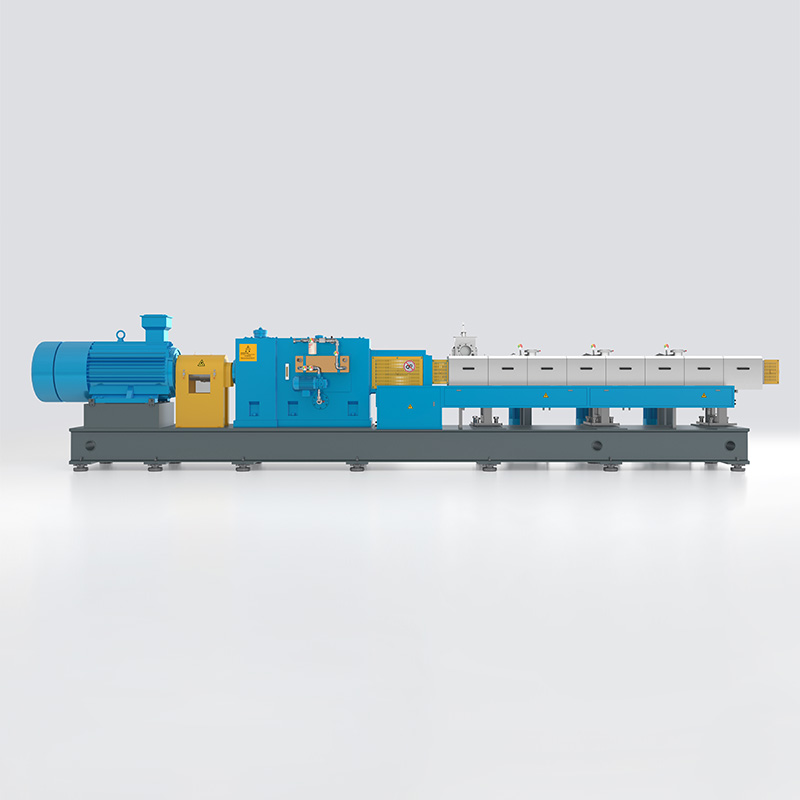 KTS High Performance Twin-Screw Extruder SeriesHigh-torque twin-screw compounding platform spanning lab to high-volume models, relevant for dispersive mixing in filled PP compounds.View Product →
Feeding Accuracy Sets the Real Tolerance Band
A 40% talc-filled PP compound needs 400 kg of filler per tonne. A half-percent error on that stream is 2 kg per tonne of finished pellet - enough to move density, warpage and modulus outside a customer's incoming inspection.
Gravimetric loss-in-weight feeders hold that error down by weighing the entire hopper and its contents; volumetric units drift with bulk density. Where fillers are light and fluffy, side feeding with negative-pressure assistance raises bulk density at the inlet and stops bridging before the material reaches the screw.
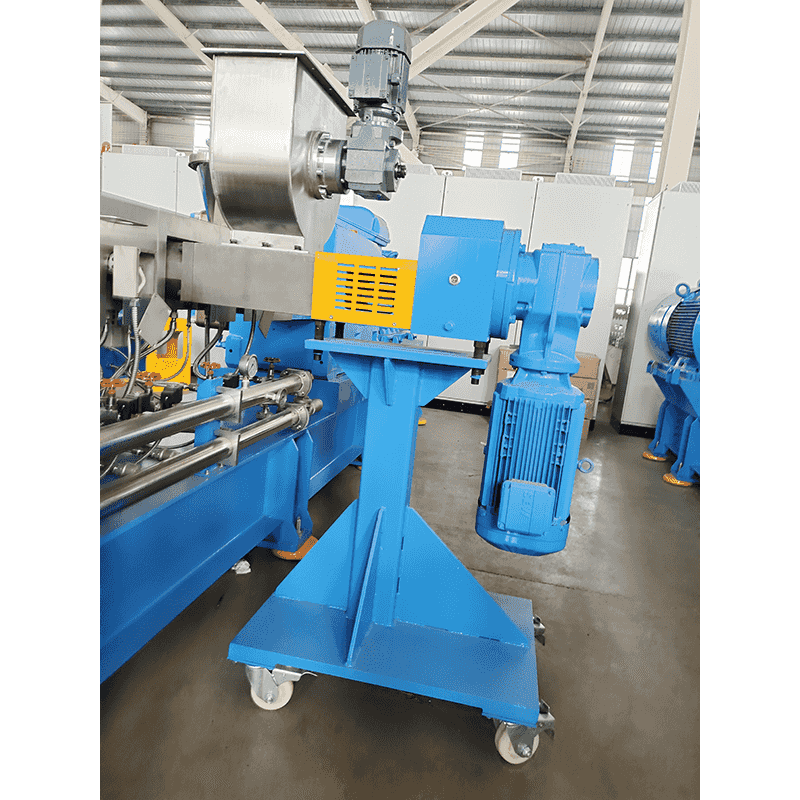 Screw Extruder Side Feeder for Powder and FiberForced side feeding of powder, short fibre or premix, with negative-pressure assistance to improve bulk density and feeding efficiency in compounding lines.View Product →
Practical check: ask for the feeder's repeatability in grams per hour at your target rate, not as a percentage of full scale. Then ask how many side-feeder ports the barrel carries, and whether later barrel sections can be reallocated when the next formulation arrives.
Cutting, Cooling and Drying: Where Money Leaks Out
Pelletizing is where a good compound becomes a good product, or a shipment of fines. Strand pelletizing with a water bath suits glass-filled grades where fibre length retention matters and the strand stays round; underwater pelletizing handles high throughput and soft or sticky melts, and a closed water loop keeps dust out of the plant air. Water-ring hot-face cutting sits between the two and is common on filled polyolefins.
Two numbers matter more than the machine type: fines below 1 mm, and moisture at the bag. Glass-fibre compounds shed fines at the cutter and at every pneumatic transfer afterwards, and those fines are fibre-rich, so a screen that removes them also removes a slice of the formulation. Drying has to be specified against the resin - PA and PBT need far more than PE or PP - and the moisture target belongs in the purchase order, not in the operator's memory.
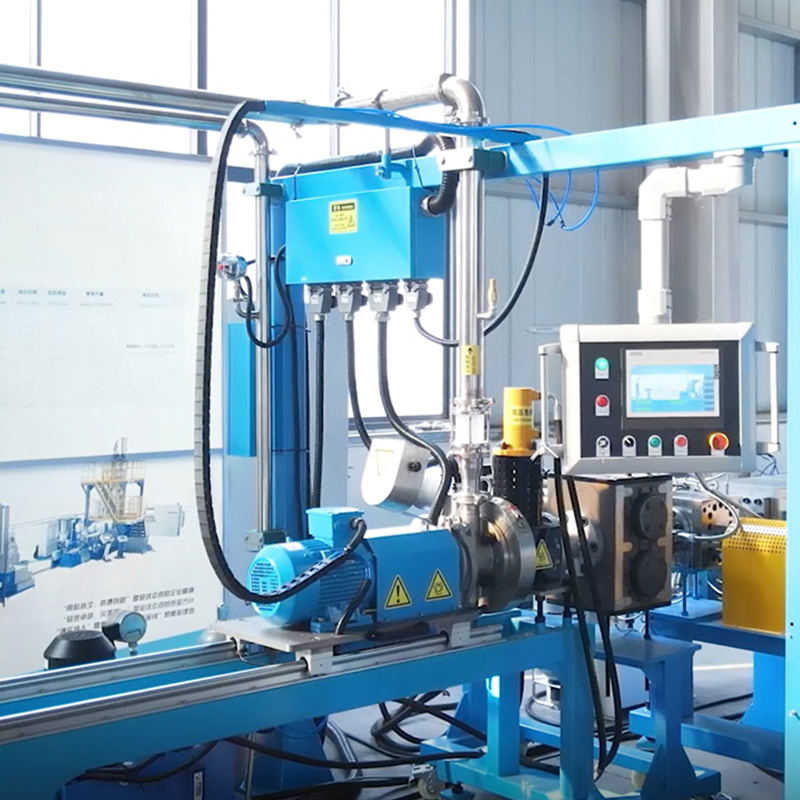 Underwater Pelletizing System for Extruded CompoundsClosed underwater die-face pelletizing converts molten compound into granules and helps limit dust, with circulating cooling water for extrusion downstream lines.View Product →
Quality Gates Worth Writing Into the Purchase Order
Standard test methods remove most arguments before they start. A workable gate set for engineering compounds looks like this:
- Tensile properties to ISO 527-2 or ASTM D638, with test speed stated - filled and unfilled grades differ.
- Flexural modulus to ISO 178; Charpy or Izod impact to ISO 179-1 or ISO 180, notched and unnotched, at a stated temperature.
- Melt mass-flow rate to ISO 1133 at a stated temperature and load; density to ISO 1183.
- Flammability to UL 94 or IEC 60695-11-10 with specimen thickness called out; comparative tracking index to IEC 60112 for electrical grades.
- Moisture on delivery by Karl Fischer or loss-on-drying, plus a pellet size distribution and fines limit.
Defects are quicker to chase when the symptom is matched to the stage that caused it.
| Symptom | Most likely stage | First thing to check |
|---|---|---|
| Black specks | Melt, residence time | Dead spots in the screw, barrel wear, colour changeover |
| Bubbles or voids | Devolatilisation, moisture | Vacuum level, vent condition, pre-drying |
| Excessive fines | Cutting, transfer | Blade wear, water temperature, air velocity |
| Fibre-rich surface, brittle corners | Dispersion, fibre attrition | Screw configuration, side feeder position, die pressure |
| Dimensions drifting between lots | Feeding, regrind ratio | Feeder calibration, virgin-to-regrind balance |
Five Questions to Ask Before You Compare Prices
- What specific torque and free volume does the quoted machine deliver at my throughput? A torque figure without a diameter and a volume figure is marketing.
- How many feeding points, and which can be side-fed? High filler and glass loads go downstream, not into the throat.
- How many devolatilisation stages, and is there a vacuum port ahead of the die? Volatiles leave at different points depending on the resin.
- Which pelletizing route, and what does a changeover cost? Strand and underwater lines have very different downtime profiles at 5 t/h and at 500 kg/h.
- What is the retrofit path? Barrels, screw elements and side feeders should be reconfigurable for the next formulation, not only this one.
Existing lines often answer these questions differently. A retrofit, such as an engineering plastic pelletising production line upgrade, can add torque and a side feeder at a fraction of a new machine's cost - provided the gearbox and barrel bores still carry margin.


