


 ENG
ENG 中文简体
中文简体 русский
 عربى
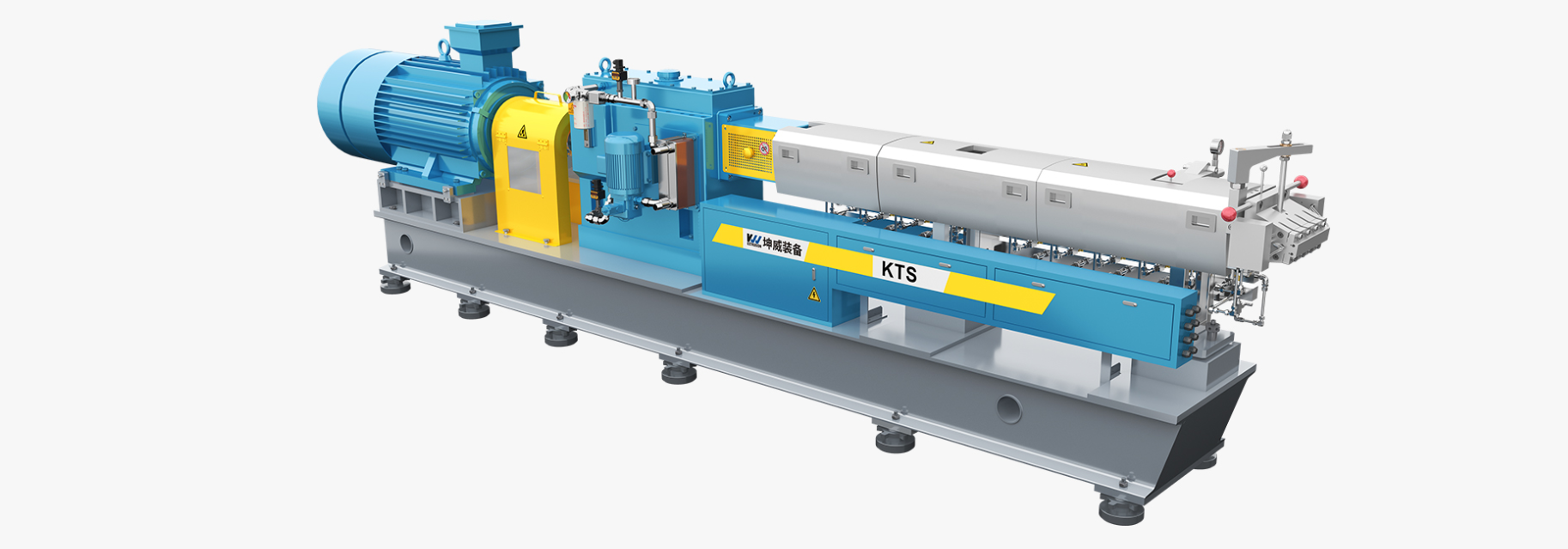
عربىHigh-speed twin-screw extrusion systems are widely used in the plastics, rubber, food, and chemical industries, and are highly efficient processing equipment. Their unique structure and working principle give them unparalleled advantages in mixing, plasticizing, melting, and granulation. Especially in material mixing, high-speed twin-screw extrusion systems are favored by many industries due to their efficient mixing performance.
1. Basic Structure and Working Principle of High-Speed Twin-Screw Extrusion Systems
A high-speed twin-screw extrusion system consists of two cooperating, rotating screws. These screws are usually arranged in parallel and can rotate in the same or opposite directions. The interaction between the two screws creates complex flow and shear forces within the equipment, resulting in highly efficient mixing. Compared to single-screw extruders, twin-screw extruders have stronger material processing capabilities, especially in processing high-viscosity materials or materials containing multiple components.
2. Mixing Effect of High-Speed Twin-Screw Extrusion Systems
High-speed twin-screw extrusion systems significantly improve material mixing through the following methods:
1) Synergistic Action of Twin Screws
The two screws of the twin-screw extruder rotate in the same or opposite directions. This design allows the material to undergo shear flow within the extruder and experience different compression, expansion, and mixing processes under the propulsion of the screws. This synergistic action ensures thorough mixing of the material, especially when processing materials containing different components.
2) Enhanced Shear Force
The rotation speed and screw design of the high-speed twin-screw extruder generate significant shear forces, resulting in more uniform mixing of the material. During the mixing process, shear forces help break down aggregates of solid particles and liquids, dispersing them into the matrix for better mixing. This is crucial for the uniform distribution of powders, granules, polymer additives, and other materials.
3) Efficient Forced Circulation Flow
Under the propulsion of the twin screws, the material forms an efficient circulating flow between the screws and the barrel. Through this flow, the material is continuously forced to circulate and come into full contact with other materials. Especially at high operating speeds, this flow allows the material to be thoroughly mixed in all areas of the extruder. Both thermoplastic and thermosetting materials can achieve a uniform mixing effect under this forced circulation.
4) Adjustable Screw Design
The screw design of high-speed twin-screw extruders is very flexible and can be customized according to specific production needs. Factors such as the screw geometry, rotation speed, and feeding method can all be adjusted to optimize the mixing effect of the material. For example, by adjusting the length of the compression and decompression zones of the screw, efficient mixing between different materials can be achieved, ensuring efficient plasticization and uniform distribution of different substances.
5) Cooperation of Temperature Control System
Temperature control during the mixing process has a significant impact on the mixing effect of the material. High-speed twin-screw extruders are usually equipped with a precise temperature control system. By controlling the temperature of the barrel, the viscosity and fluidity of the material can be effectively adjusted, preventing material sticking or premature cooling due to excessively high or low temperatures. Precise temperature control helps ensure thorough mixing of the material within the extruder, thereby improving the quality of the final product.
3. Advantages of High-Speed Twin-Screw Extrusion Systems
Compared to other mixing equipment, high-speed twin-screw extrusion systems have many significant advantages in terms of mixing effect:
1) High-Efficiency Mixing Capability
Due to its unique screw design and efficient material handling capabilities, the high-speed twin-screw extruder can process different types of materials, including various thermoplastics, rubber, food additives, pharmaceutical powders, etc. Regardless of the viscosity, particle size, or physical characteristics of the material, the twin-screw extruder can provide efficient and uniform mixing.
2) Ability to Process Multiple Materials
High-speed twin-screw extrusion systems can process a variety of different types of materials, including complex materials such as heat-sensitive, thermoplastic, or polymer materials. By adjusting the screw design and operating conditions, the equipment can be compatible with various materials and provide optimal mixing results.
3) Reduced Excessive Oxidation Reactions
Compared to single-screw extruders, twin-screw extruders offer more controllable processing temperature and time, which effectively reduces oxidation reactions of materials at high temperatures, especially making the processing of heat-sensitive materials safer. This controllable temperature and uniform mixing ensure the output of high-quality products. 4) Adapting to Complex Processing Needs
High-speed twin-screw extrusion systems are not only suitable for simple material mixing but can also handle more complex processing needs, such as the addition of fillers, plasticizers, foaming agents, and the processing of high-performance materials. Its flexibility allows this system to meet various challenges in different production processes.
4. How to Optimize the Mixing Effect of High-Speed Twin-Screw Extrusion Systems
To further improve the mixing effect of high-speed twin-screw extrusion systems, the following methods are worth considering:
1) Fine-tuning Screw Design
Adjust the geometry, length, clearance, and speed of the screws according to different production needs to achieve the optimal mixing effect. For example, for materials requiring high shear force, higher speeds and tighter screw clearances can be used.
2) Optimizing Feeding Method
Design the feeding port appropriately to ensure that all types of materials can enter the extruder smoothly and evenly. The design of multiple feeding ports helps to achieve uniform material distribution, thereby improving the mixing effect.
3) Precise Control of Temperature and Pressure
During processing, temperature and pressure are important factors determining the mixing effect. By precisely controlling the barrel temperature and internal pressure, the viscosity and fluidity of the material can be effectively adjusted, preventing uneven mixing caused by excessively high or low temperatures.
4) Regular Cleaning and Maintenance
Regular cleaning and maintenance of the screws and barrel of the high-speed twin-screw extruder are essential to prevent material residue, blockage, or adhesion. This helps maintain the efficient operation of the equipment and ensures the stability of the mixing effect.
5. Frequently Asked Questions (FAQ)
Q1: What materials are suitable for mixing with high-speed twin-screw extrusion systems?
A1: High-speed twin-screw extrusion systems are suitable for a variety of materials, including plastics, rubber, food, pharmaceuticals, and other additives. They are particularly suitable for processing materials with high viscosity or those requiring efficient plasticization and mixing.
Q2: How to determine if the mixing effect of a high-speed twin-screw extrusion system meets the standards?
A2: The mixing effect can be judged by observing indicators such as product uniformity, color difference, particle distribution, and physical properties. If the mixing is uneven, adjustments to the screw design or process conditions may be necessary.
Q3: Is the energy consumption of high-speed twin-screw extrusion systems high? A3: Compared to single-screw extruders, high-speed twin-screw extruders typically require higher power to drive the two screws. However, their efficient mixing and processing capabilities can optimize production efficiency and reduce energy waste to some extent.
Q4: How to improve the production efficiency of a twin-screw extruder?
A4: Production efficiency can be improved by optimizing screw design, adjusting processing temperature, rationally selecting feed rate and speed, and performing regular equipment maintenance. Proper control of process parameters can also effectively improve production efficiency.


