


 ENG
 中文简体
 русский
 عربى
A twin-screw extruder can have a well-designed screw profile and still miss its dispersion target because the gearbox runs out of torque. The gearbox is the quiet constraint in many compounding lines: it converts motor speed into shaft speed, multiplies torque, splits that torque across two shafts, and absorbs the axial thrust created by melt pressure. When a line is upgraded for higher filler loading, lower melt viscosity, or higher throughput, the gearbox is often the first component to reach its limit and the last one to be rechecked. This guide covers the selection numbers that matter, the failure modes that cost uptime, and the maintenance checks that keep a screw gearbox inside its design envelope.
Content
- 1 What a screw gearbox actually does in a twin-screw extruder
- 2 Torque density: the number that shapes the whole machine
- 3 Thrust load, bearings, and the limits you cannot see
- 4 Matching the gearbox to the process, not just the motor
- 5 Lubrication and maintenance: where gearbox life is won or lost
- 6 Final check before you approve the gearbox
- 7 Screw gearbox FAQ: questions buyers actually ask
- 7.1 What is a screw gearbox in a twin-screw extruder?
- 7.2 What specific torque do I need for compounding?
- 7.3 How do I size a gearbox for high filler loading?
- 7.4 Why does gearbox oil overheat?
- 7.5 How often should a screw extruder gearbox be serviced?
- 7.6 Can a gearbox be upgraded on an existing extrusion line?
What a screw gearbox actually does in a twin-screw extruder
In a single-screw extruder, the gearbox is mainly a reducer. In a twin-screw compounding extruder, it is a distribution gearbox. Motor input passes through one or more gear stages, then the torque is split between two output shafts that must remain precisely timed. The output shafts carry the screws, so the gearbox has to manage radial load from screw weight and, more critically, axial thrust from melt pressure at the die.
That split introduces two design pressures. First, the gear teeth and bearings on each output shaft must share load evenly. If load sharing is poor, one shaft carries more torque and the gearbox loses life before its nameplate rating is reached. Second, the thrust bearings must absorb axial force without allowing the screws to move axially. Small axial movement changes screw-to-barrel clearance and can cause wear, metal contact, or inconsistent mixing. Gearbox selection is therefore not a simple motor-matching exercise: it is a torque, thrust, and thermal decision.
Torque density: the number that shapes the whole machine
Specific torque, usually written as Md/a³, is the maximum allowable torque per unit of centerline distance cubed. It is the clearest way to compare gearboxes across screw diameters. A 14 Nm/cm³ gearbox does not simply have more torque; it allows a smaller screw diameter to transmit the same torque, which changes shear history, surface renewal, and residence time.
The chart is a calculated comparison, not a bench test: for the same torque, relative screw diameter falls as torque density rises. In practice, a higher torque density machine usually needs stronger shafts, larger bearings, better oil cooling, and tighter manufacturing tolerances. KUNWEI states that its modified-application design reaches up to 14 Nm/cm³, with screw diameters from 8 mm to 177 mm. That claim should be checked against the full duty cycle, not just peak torque, because the gearbox must also survive start-up, transient loading, and high-fill masterbatch campaigns. For a broader explanation of how high-torque twin-screw extruders improve processing, see this technical note on high-torque twin-screw extruders.
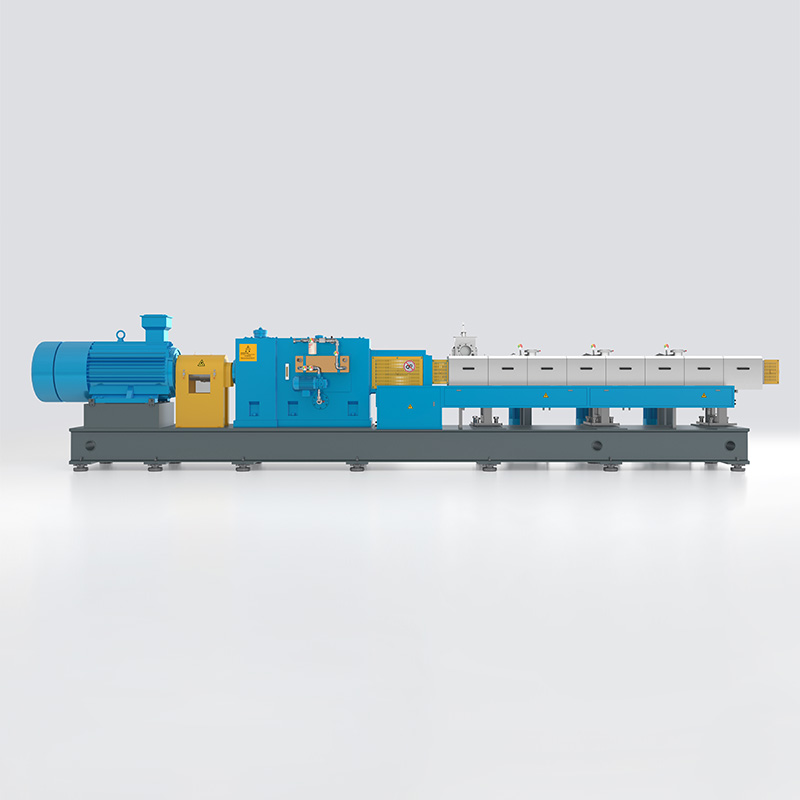 KTS High Performance Twin-Screw Extruder SeriesA high-torque twin-screw extruder series for engineering plastics, with multiple models and torque ratings to assess against full duty cycle and thrust capacity.View Product →
Use the torque rating as a starting point, then ask for the allowable thrust at the design die pressure. A gearbox that is strong in torsion but short on thrust capacity will still lose bearing life in a high-fill line.
Thrust load, bearings, and the limits you cannot see
Axial thrust is generated by the pressure difference between the screw tip and the feed throat, and it rises with die resistance, high filler loading, and low melt index. The thrust bearing is therefore a gearbox's most sensitive mechanical component. Bearing life is not linear with load: a modest increase in thrust can reduce L10 life sharply. The gearbox supplier should provide the allowable thrust at the specified screw speed and the oil flow required to carry heat away from the bearings.
| Check | What to ask | Why it matters |
|---|---|---|
| Specific torque | What is the rated Md/a³ at the design screw speed? | Sets the torque ceiling and the maximum filler load for a given screw diameter. |
| Thrust capacity | What axial load can the thrust bearing accept at design die pressure? | Determines bearing life and screw clearance stability. |
| Oil cooling | What oil flow and cooling capacity are required at low speed, high torque? | Prevents bearing overheating when the line runs at high torque and low screw speed. |
| Shaft timing | How is torque split between the two output shafts verified? | Poor load sharing reduces gear and bearing life. |
| Service access | Can the thrust bearing be inspected without removing the whole gearbox? | Affects repair time and the cost of a planned rebuild. |
Oil temperature is a useful early warning. If the gearbox oil runs hot at moderate load, the problem may be cooling water flow, a blocked oil filter, or a bearing preload issue, not simply a hot day. A gearbox with adequate thermal capacity will hold oil temperature within the supplier's range across the full screw speed range. If the line is expected to run at low speed and high torque, check that the oil pump is driven independently of the input shaft; otherwise lubrication can fall at exactly the moment the bearings need it most.
Matching the gearbox to the process, not just the motor
Two lines can use the same motor and the same screw diameter but place very different demands on the gearbox. A color masterbatch line runs at moderate torque with frequent grade changes; a high-fill masterbatch line runs at high torque and high side-feeder load; a reactive extrusion line may need tight temperature control and sustained torque at low speed. For high-volume, high-fill work, the gearbox should be selected with the extruder's volumetric capacity, not only the motor nameplate. A large-capacity machine can run at lower screw speed and still deliver output, which reduces shear heating and improves feed intake.
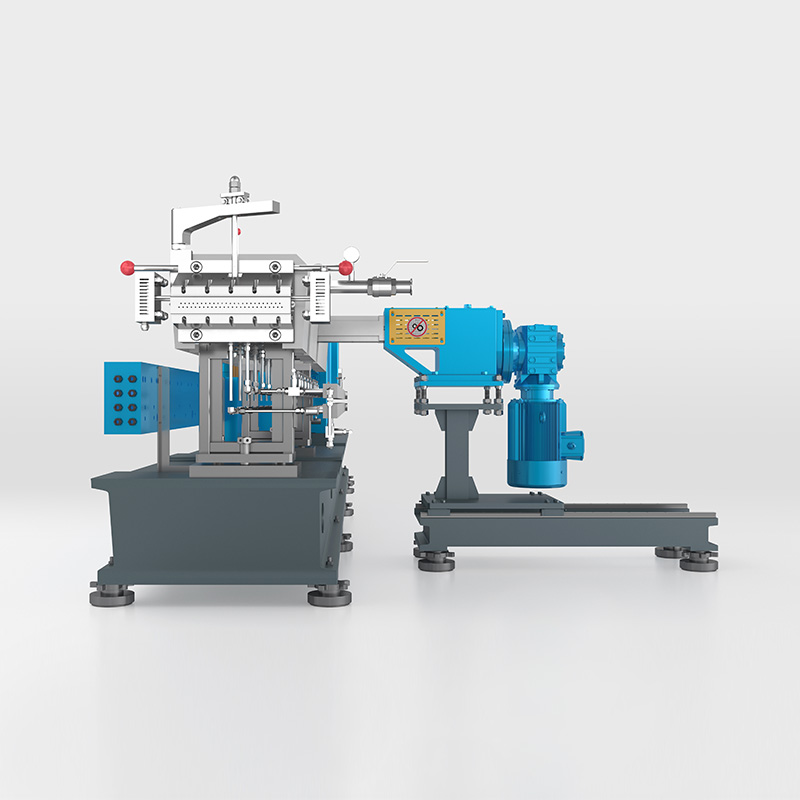 KTD High Volume Twin-Screw Extruder LineA high-torque production line for compounding, blending modification and challenging materials, suited to high-volume, high-fill work where volumetric capacity guides gearbox selection.View Product →
The process also determines the auxiliary package. High filler loadings usually need side feeding, and feeder accuracy affects torque stability: a surge of powder can raise melt pressure and thrust in seconds. In pharmaceutical hot-melt extrusion, torque demand is often lower, but documentation, cleanability, and temperature stability requirements are higher. The gearbox is only one part of that system, but it is the part that sets the torque ceiling.
Lubrication and maintenance: where gearbox life is won or lost
Most screw gearbox failures are not sudden. They start with oil oxidation, filter loading, seal weeping, or a slow rise in vibration. A practical maintenance program tracks four things: oil condition, oil temperature, filter differential pressure, and vibration trend. Oil analysis should check viscosity, water content, ISO cleanliness, and wear metals. A rising iron or copper reading is more useful than a single pass result because it shows a trend.
- Change oil at the interval recommended for the oil type and operating temperature; high-torque compounding duties often need shorter intervals than catalog values.
- Inspect breathers and seals for dust ingress; a blocked breather can pressurize the housing and push oil past the seals.
- Verify cooling water flow and oil cooler condition before summer production; a fouled cooler shows up as high oil temperature at normal load.
- Record vibration at the same load and speed points each month; a changing spectrum is an early bearing warning.
- Keep a spare set of filters, seals, and critical bearings; waiting for a custom bearing to ship can turn a weekend repair into a two-week stoppage.
 Extruder Spare Parts and Service SupportA spare-parts catalog for extruder maintenance, with inventory and logistics support, useful when planning gearbox checks and replacement parts.View Product →
If the gearbox is being rebuilt, check output shaft alignment and thrust bearing preload before the unit returns to service. A gearbox reassembled without those checks can run quietly and still fail early.
Final check before you approve the gearbox
A screw gearbox is not a catalog item that can be chosen after the screw design is fixed. It sets the torque ceiling, the thrust limit, and the thermal margin of the whole line. Before you compare price, compare specific torque at the design screw speed, allowable thrust at the design die pressure, oil cooling capacity, and service access for bearings and seals. If those four items are not documented, the quote is incomplete.
KUNWEI builds twin-screw extrusion systems for compounding, chemical, and pharmaceutical applications, with KTS and KTD platforms and a spare parts program. If you are checking whether an existing gearbox can handle a new formulation, talk to a KUNWEI engineer about the duty cycle and thrust data.
Screw gearbox FAQ: questions buyers actually ask
What is a screw gearbox in a twin-screw extruder?
It is the distribution gearbox that reduces motor speed, multiplies torque, splits torque to two timed output shafts, and absorbs axial thrust from the screws. It is not just a speed reducer.
What specific torque do I need for compounding?
Start with the process: high-fill and engineering plastics usually need higher torque density than color masterbatch. Check the gearbox rating at the expected screw speed and thrust load, not only the peak torque number.
How do I size a gearbox for high filler loading?
Match the gearbox to the maximum filler percentage, side-feeder surge, and die pressure. Ask for allowable thrust at the design melt pressure and confirm oil cooling capacity at low screw speed.
Why does gearbox oil overheat?
Common causes are low cooling water flow, a fouled oil cooler, a blocked filter, wrong oil viscosity, or bearing preload. Check oil temperature at the same load and speed before changing the oil grade.
How often should a screw extruder gearbox be serviced?
Follow the OEM interval for oil and filters, then adjust for duty. High-torque, high-temperature lines often need shorter oil intervals and monthly vibration checks. Oil analysis is the best guide.
Can a gearbox be upgraded on an existing extrusion line?
Yes, but the upgrade must include the screw shafts, thrust bearings, lubrication, and safety interlocks. A higher-torque gearbox bolted to an existing barrel can expose the weakest component elsewhere.


