


 ENG
ENG 中文简体
中文简体 русский
 عربى
عربىA halogen-free low-smoke sheathing compound usually carries 55 to 65 percent by weight of aluminium trihydroxide or magnesium dihydroxide. When that mineral is not fully de-agglomerated and wetted by the polymer melt, the cable still looks perfect on the reel. The problem appears later: a failed smoke density test, cracking during a cold bend, or a slow drop in insulation resistance after accelerated ageing.
That is why electric cable compounds are best understood as a joint product of formulation and process. The recipe sets the target; the compounding line decides whether the pellet actually delivers it. Screw geometry, side feeding of fillers, temperature control and a matched pelletizing system together determine dispersion quality, moisture level and batch-to-batch consistency.
This article breaks down the main compound families, the performance requirements they must hit, the points where compounding most often fails, and what to verify when you specify a production line.
Content
- 1 What Counts as an Electric Cable Compound
- 2 The Performance Requirements a Compound Must Satisfy
- 3 Why Filler Loading and Dispersion Decide Cable Performance
- 4 Choosing a Twin-Screw Compounding Line for Cable Compounds
- 5 Feeding: Where High Filler Loadings Succeed or Fail
- 6 Pelletizing and Downstream Handling
- 7 A Practical Selection Checklist
- 8 Frequently Asked Questions About Electric Cable Compounds
- 8.1 Q1. What are electric cable compounds made of?
- 8.2 Q2. What is the difference between LSZH and PVC cable compounds?
- 8.3 Q3. Why does specific torque matter in cable compound extrusion?
- 8.4 Q4. What filler loading can a twin screw extruder handle?
- 8.5 Q5. How do you prevent moisture and voids in cable compound pellets?
- 8.6 Q6. Which pelletizing system is best for LSZH cable compounds?
What Counts as an Electric Cable Compound
The term covers every engineered polymer system used inside or around a cable: conductor insulation, semiconductive screens, bedding compounds and the outer sheath. These families differ far more in filler loading than in base polymer, and that single fact drives the equipment decision.
| Compound family | Typical base polymer | Primary function | Filler or additive level |
|---|---|---|---|
| PVC insulation and sheath | PVC with plasticizer | General wiring, flexible cords | 20-50 phr calcium carbonate plus plasticizer |
| XLPE power insulation | LDPE or silane-grafted PE | Medium and high voltage insulation | Under 2 percent (antioxidant, crosslinking agent) |
| HFFR / LSZH sheath | EVA, LLDPE, EPDM blends | Flame-retardant, low-smoke jacketing | 55-65 percent ATH or MDH |
| Semiconductive shielding | EVA or EBA copolymer | Conductive screen around conductor and insulation | 30-40 percent conductive carbon black |
| Specialty jackets | TPU, PA12, PBT | Abrasion, oil and cut resistance | 5-25 percent additives |
The practical consequence is that one line rarely suits all of them. A machine built for 60 percent ATH filling has very different feeding, torque and wear-protection requirements from one running unfilled XLPE insulation, and switching between the two without a screw-configuration change usually costs more in scrap than it saves in scheduling.
The Performance Requirements a Compound Must Satisfy
Cable standards translate into a fixed list of measurable targets. A compound that misses any one of them will not pass type approval, however well it runs on the extruder.
- Dielectric strength and volume resistivity, verified before and after water ageing.
- Flame retardancy, expressed as limiting oxygen index and confirmed through single-burner fire tests.
- Smoke density and toxicity, the defining requirement for LSZH and HFFR grades used in tunnels, stations, hospitals and data centres.
- Halogen acid gas evolution, measured under IEC 60754 and EN 50267 for halogen-free specifications.
- Mechanical behaviour: tensile strength, elongation at break, hot deformation and cold bend at low temperature.
- Ageing resistance: retention of elongation after oven ageing, plus oil, ozone and UV resistance where relevant.
The chart is a qualitative industry comparison rather than a numeric specification, and it explains why no single family wins everywhere. HFFR grades lead on fire performance and trail on cost and flexibility. PVC leads on cost and processing ease and trails on smoke and halogen content. XLPE leads on dielectric behaviour and offers almost no flame retardancy on its own.
Why Filler Loading and Dispersion Decide Cable Performance
Halogen-free systems rely on endothermic mineral fillers. Aluminium trihydroxide starts releasing water above roughly 200 degrees Celsius and magnesium dihydroxide above roughly 300 degrees Celsius. That sets a narrow processing window: the melt must be hot enough to wet out and disperse the filler, yet cool enough that the filler does not decompose inside the barrel. Holding zone temperature within plus or minus 2 degrees Celsius is a realistic target on a well-controlled line, and it is one of the clearest differences between a stable process and an inconsistent one.
Dispersion quality controls three outcomes at once. Agglomerates behave as local fuel-rich zones and reduce flame retardancy. Unwetted particles become crack initiation points and cut elongation at break. Poor wetting also shows up as surface defects on the finished cable. In practice two levers matter most: surface treatment of the filler with a silane or titanate coupling agent to lower interfacial tension and torque demand, and a split feeding strategy in which the polymer melts first and part of the filler is added downstream.
Choosing a Twin-Screw Compounding Line for Cable Compounds
Co-rotating intermeshing twin-screw extruders dominate cable compound production because they combine conveying, melting, dispersive mixing, distributive mixing and devolatilization in one machine with an adjustable screw profile. Three specification numbers decide whether a given machine can hold a heavily filled formulation at production rate: specific torque in Nm per cubic centimetre, the screw diameter and outer-to-inner diameter ratio, and the balance between throughput and residence time.
Specific torque is the most useful single indicator for filled compounds. Higher torque means more useful work per revolution before the screw shaft reaches its limit, which leaves room for kneading blocks that actually break down filler agglomerates instead of merely conveying them. KUNWEI's KTS high-performance series is built around this requirement, with the company specifying a maximum specific torque of 14 Nm/cm³ for its compounding machines and a barrel range from 8 mm to 177 mm covering laboratory trials through industrial output.
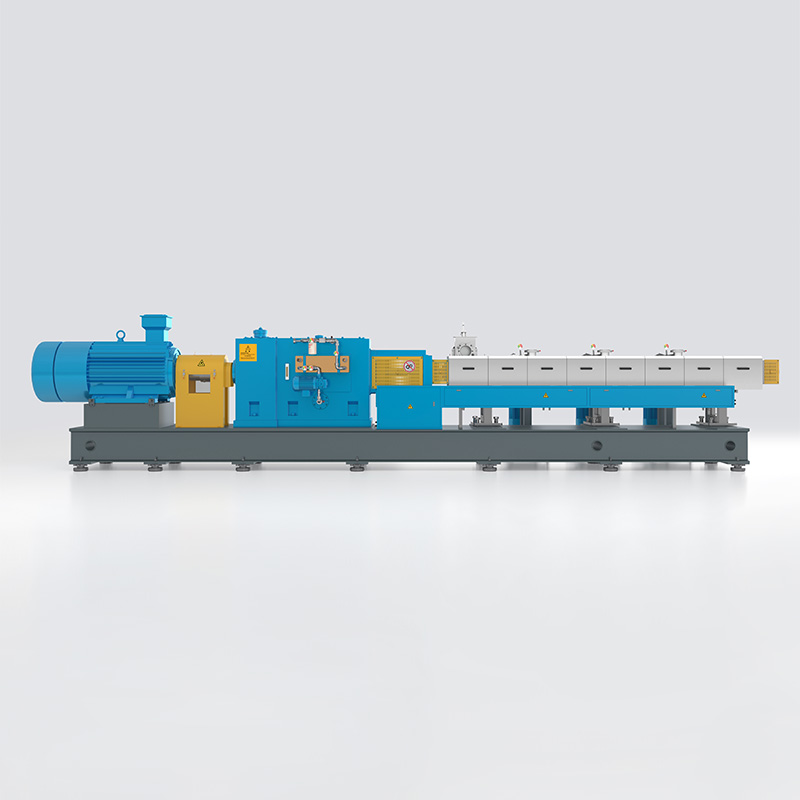 KTS High Performance SeriesTechnical ParametersView Product →
Screw configuration is not a fixed feature. For a 60 percent ATH formulation, the usual layout alternates conveying elements with staggered kneading blocks and includes at least one upstream and one downstream vacuum devolatilization port to pull off moisture released by the filler.
The mixing mechanics behind these choices are examined in more detail in this technical note on the shearing and mixing behaviour of a large-capacity high-filler granulation line, which is directly relevant to heavily filled cable sheathing grades.
Feeding: Where High Filler Loadings Succeed or Fail
Most dispersion problems that look like screw-design issues actually start at the feed throat. Loss-in-weight feeders hold accuracy around plus or minus 0.5 percent of set rate, but accuracy is not the same as consistency. Powders with low bulk density, high moisture pick-up or a wide particle-size distribution can bridge, flush or pulse, and the extruder downstream simply receives an unstable formulation.
Above roughly 40 percent filler loading, splitting the feed between the main throat and a downstream side feeder is standard practice. The polymer melts first and the filler is introduced into an already viscous melt, which reduces torque peaks and improves wetting. A side feeder using negative-pressure feeding also raises the effective bulk density of light powders such as ATH, so more filler reaches the melt per screw revolution.
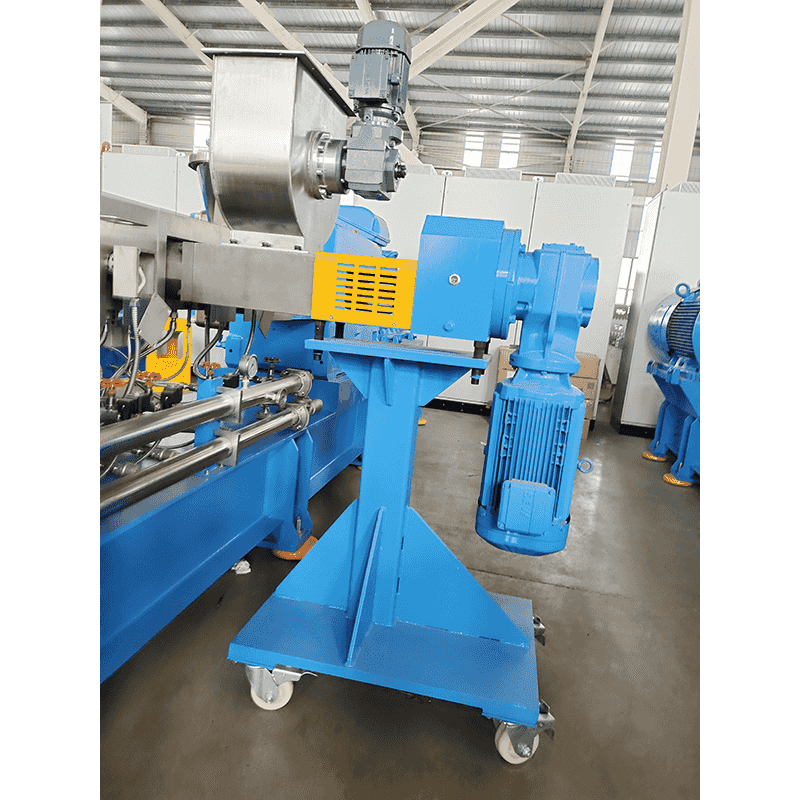 Side FeederThe side feeder is used for forced feeding of powder, short fiber or premix material, which can flexibly meet the process needs or increase the feeding amount. At the ...View Product →
For heavily filled cable compounds, the feeding package usually combines a loss-in-weight main feeder for polymer and additive premix, a side feeder for the mineral filler, and a liquid injection point for coupling agents or processing aids where the formulation calls for it.
Pelletizing and Downstream Handling
The pelletizing choice follows the formulation, not the other way around. Strand pelletizing remains the most economical route for low-to-medium filler grades and gives operators an easy visual check of dispersion quality. Water ring hot-face cutting suits PVC and other temperature-sensitive compounds. Underwater pelletizing suits highly filled HFFR and LSZH grades, because the die face is cut immediately in water, producing uniform spherical pellets, lower dust levels and less die-plate build-up on sticky, low-viscosity melts.
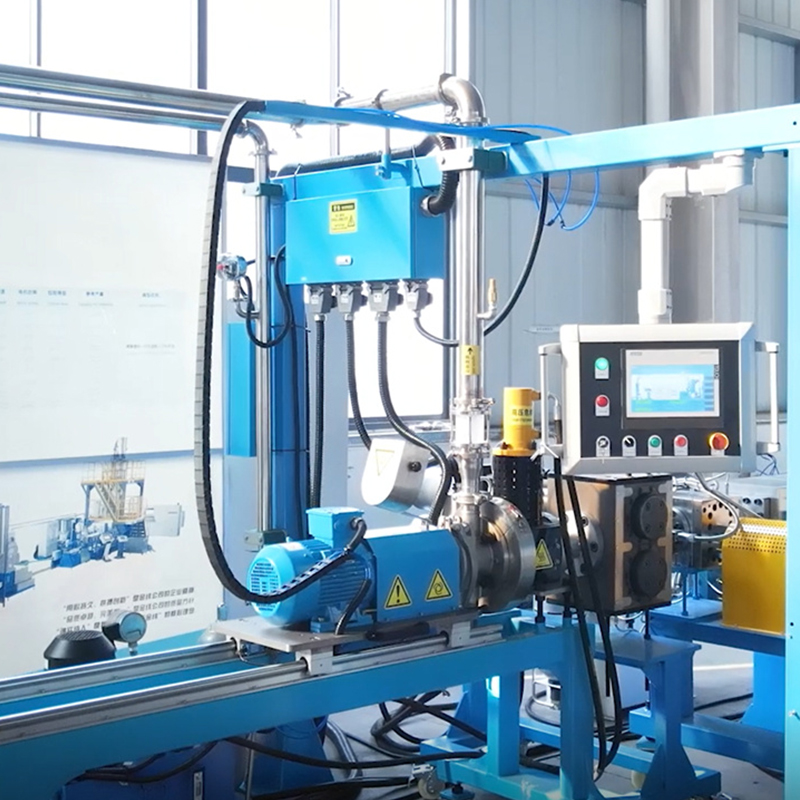 Underwater PelletizingUnderwater die surface hot cutting means that the material is cut into particles in water, and directly follows the water flow into the pipeline for cooling and shaping.View Product →
Downstream, a vibrating sieve removes fines and oversize pellets, and a storage and conveying system keeps the finished compound sealed against moisture pick-up. That last point is easy to underestimate: a cable compound that leaves the line at specification can still drift out of tolerance after a few weeks in an open container, particularly when the filler fraction is high.
Where an existing line is being upgraded rather than built from scratch, the same logic applies to the whole sequence from feeding to sieving. A useful reference is this outline of a large-capacity high-filler granulation production line, which shows how the individual process sections are sequenced in practice.
A Practical Selection Checklist
When comparing compounding equipment for cable compounds, these are the points that separate a line that works from one that needs constant attention.
- Run the actual formulation, not a generic polyolefin, on the supplier's trial line before committing; filled systems behave very differently from unfilled ones.
- Confirm torque reserve at the target throughput, not at the machine's published maximum.
- Check whether filling above 40 percent is handled by a side feeder with adequate conveying capacity for low-bulk-density powders.
- Verify temperature control tolerance across all barrel zones, since mineral fillers set a hard upper limit.
- Match the pelletizing system to melt viscosity and stickiness rather than to the machine size alone.
- Ask about wear protection on screws and barrels, and about spare-part lead times for high-wear components.
Frequently Asked Questions About Electric Cable Compounds
Q1. What are electric cable compounds made of?
A base polymer such as PVC, LDPE, EVA or EPDM, combined with mineral fillers, flame retardants, stabilizers, coupling agents, colorants and processing aids. The exact recipe depends on whether the compound is used for insulation, semiconductive screening or an outer sheath.
Q2. What is the difference between LSZH and PVC cable compounds?
PVC compounds rely on chlorine for flame retardancy and release halogen acid gas and dense smoke when burned. LSZH (low smoke zero halogen) compounds use mineral fillers such as ATH or MDH instead, producing far less smoke and no halogen acid, at higher material cost and higher filler loading.
Q3. Why does specific torque matter in cable compound extrusion?
Specific torque determines how much mixing work the screw can perform per revolution. Halogen-free flame retardant compounds need strong dispersive mixing to break down filler agglomerates, and a low-torque machine cannot sustain that at production rate.
Q4. What filler loading can a twin screw extruder handle?
Modern co-rotating twin screw lines routinely run HFFR and LSZH formulations at 55 to 65 percent mineral filler by weight, provided that feeding is split between the main throat and a side feeder and that the temperature profile avoids premature filler decomposition.
Q5. How do you prevent moisture and voids in cable compound pellets?
Use vacuum devolatilization on the extruder, keep filler storage dry, and seal the finished pellets against moisture pick-up. Voids and surface defects usually trace back to moisture entering with the filler or to insufficient devolatilization capacity.
Q6. Which pelletizing system is best for LSZH cable compounds?
Underwater pelletizing is the common choice for highly filled, low-viscosity HFFR and LSZH melts because cutting takes place immediately at the die face in water, giving uniform pellets and reducing dust and die build-up.


