


 ENG
ENG 中文简体
中文简体 русский
 عربى
عربىStand at a manual feeding station for one shift and the pattern repeats: the operator scoops additive from a bag, the scale overshoots, some is scooped back, and the record still reads 25.0 kg. Across eight ingredients and three shifts, those small corrections become measurable variance in every batch. Automated ingredient weighing and dosing replaces this human-dependent loop with load cells, screw-type feeders and programmable control that locks each component to a repeatable target. This article explains how to automate weighing and dosing on a twin-screw compounding line: the weighing principles, the equipment architecture, the selection criteria, and the implementation steps that avoid costly mistakes.
Content
Why Automate Weighing and Dosing on a Compounding Line
The business case starts with repeatability. A loss-in-weight feeder measures its own weight loss over time and corrects screw speed in real time, so a change in bulk density no longer changes the delivered mass. Manual weighing depends instead on operator technique, scale settling time and scooping method — all sources of random error.
What automation actually changes
- Accuracy that holds over time: gravimetric dosing typically keeps deviation within ±0.25–0.5% of setpoint, while manual batch weighing commonly varies by ±2–3%.
- Digital recipe management: target weights, tolerances and feed sequences are stored in the controller; every batch is logged for traceability and quality audits.
- Cleaner and safer operation: operators work away from dust and repetitive lifting; enclosed transfer reduces spillage, contamination and material loss.
- Faster changeover: switching recipes is a parameter change on the HMI, not a re-measurement exercise with notes and guesswork.
The same principle applies across masterbatch, engineering plastics, high-fill systems and biodegradable modification: only what is measured can be held constant.
Volumetric or Gravimetric: Decide the Weighing Principle First
The first decision is not which feeder model, but which weighing principle. A volumetric feeder doses by volume: screw speed determines output, so if bulk density shifts — through moisture, segregation or refill packing — the delivered mass shifts as well. A gravimetric feeder doses by mass: load cells continuously measure weight and the controller adjusts speed to hold mass flow constant. For critical or expensive ingredients, and for most continuous extrusion processes, gravimetric loss-in-weight control is the reference technology. You can read more about the control principle behind loss-in-weight feeding in our detailed explanation.
Gain-in-weight is the batch form of the same idea: material is fed into a vessel until the scale reaches the target, then discharged. It fits batch mixing, minor additives and premix recipes that need a fixed weight per cycle. The practical rule: continuous extrusion and critical dosage should use loss-in-weight; discrete batch recipes can use gain-in-weight; non-critical materials with stable bulk density can be dosed volumetrically at lower cost.
| Feeder type | Weighing principle | Typical accuracy | Best suited for | Watch out for |
|---|---|---|---|---|
| Loss-in-weight feeder | Gravimetric, continuous | ±0.25–0.5% of setpoint | Powders, pellets and low-dose additives on extrusion lines | Refill cycle briefly disturbs measurement |
| Automatic weight feeder | Gravimetric, batch (gain-in-weight) | ±0.5–1% of target | Discrete batch recipes, minor ingredients | Cycle time per batch |
| Volumetric screw feeder | Volumetric | ±1–2% of setpoint | Stable bulk-density materials, coarse pellets | Density drift changes delivered mass |
| Conical (tapered) feeder | Volumetric, can be gravimetric | Depends on configuration | Low-dose additives and high-filler systems | Taper geometry must match powder flow |
Comparing the two control approaches at a glance
The radar chart below compares volumetric and gravimetric dosing across the five criteria that matter most on a compounding line. Gravimetric control wins on accuracy and continuous-process fitness at the cost of higher initial investment; volumetric control remains attractive when tolerances are relaxed.
How real accuracy compares
Accuracy figures refer to the maximum deviation from setpoint under stable conditions. The gap between manual practice and gravimetric control is where the return on automation comes from.
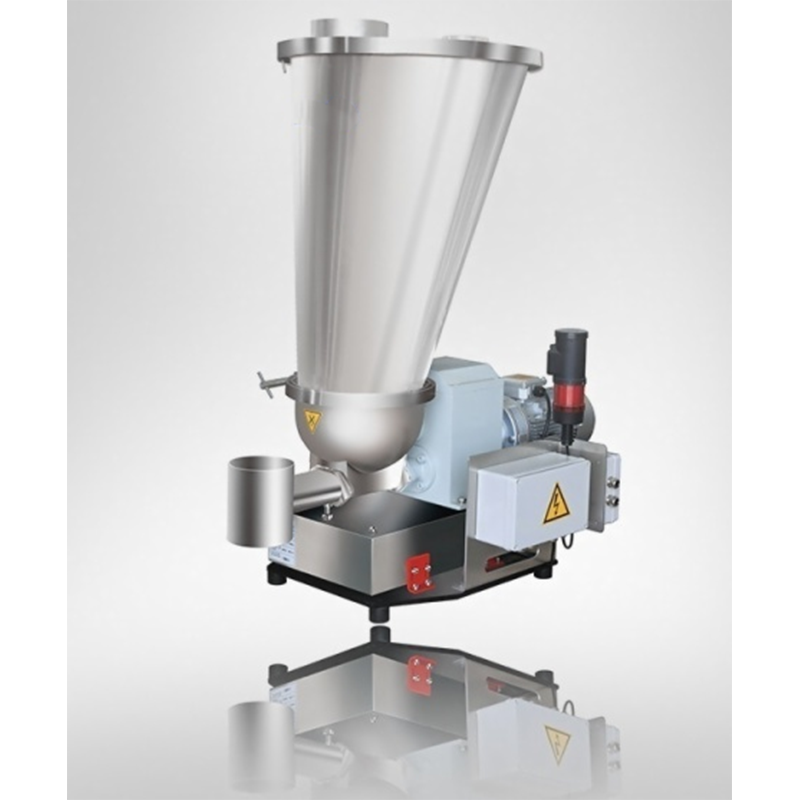 Gravimetric Loss-in-Weight Feeder with Integrated ControlThis solution combines storage, weighing, conveying, and closed-loop dosing for continuous compounding lines. It suits operators seeking precise gravimetric control and automation to reduce deviation from setpoint.View Product →
Anatomy of an Automated Dosing System for an Extrusion Line
An automated dosing station is a chain of four functions: storage and discharge, weighing, conveying into the process, and control. The schematic below shows a typical configuration on a twin-screw compounding line — a loss-in-weight feeder with hopper and load cells feeding the barrel, a side feeder for high-fill powder, and a central control cabinet running the recipes and closed-loop dosing.
Material leaves the hopper and passes through the feeder screw; the load-cell module reports weight loss to the controller; the controller adjusts screw speed continuously; and each dosing event is recorded against the batch number. The same architecture scales from a single feeder to a full compounding line with ten or more ingredients.
The effect on process stability shows up quickly in batch data. In the illustrative trend below, a manual station wanders as operators and material properties change, while the automated line holds a narrow band around the target weight.
For batch-style premix or weigh-and-dump operations, an automatic weight feeder performs gain-in-weight dosing into a receiving vessel. Because the target weight is entered from the HMI, recipe changes take seconds, and the system automatically flags any dose that falls outside tolerance.
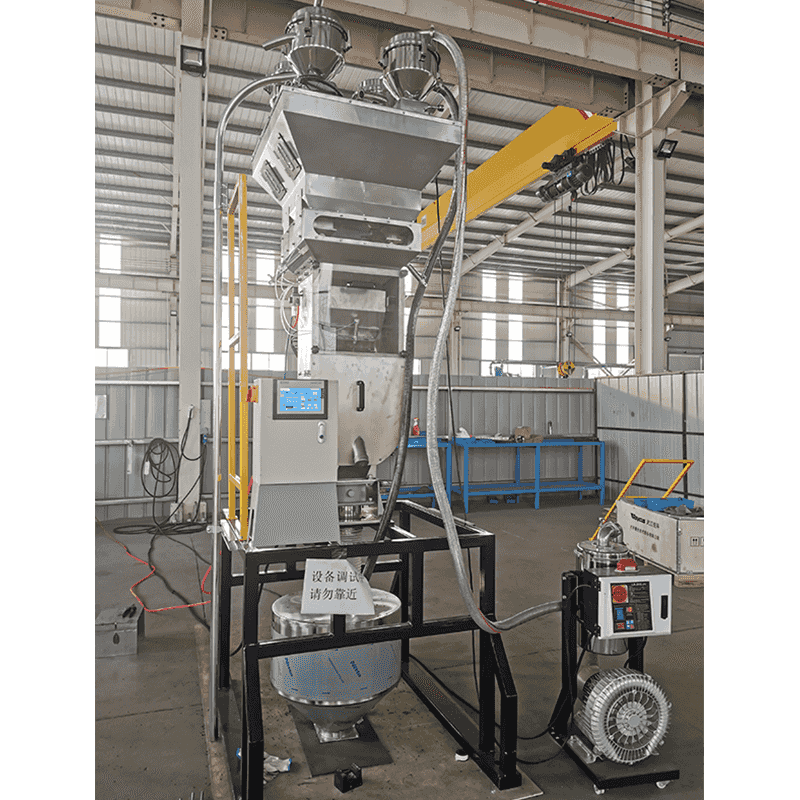 Automatic Gain-in-Weight Batching and Mixing SystemDesigned for batch premix or weigh-and-dump operations, this system automatically measures each ingredient into the mixer. It simplifies recipe changes via HMI and flags out-of-tolerance doses for consistent product quality.View Product →
Selection Criteria and Common Procurement Mistakes
Feeder selection is decided by the powder, not by the brochure. A checklist that covers material behavior and process interface will prevent most failed installations.
- Material properties: bulk density and its variability, particle size, flowability, moisture and temperature limits.
- Accuracy requirement: define the tolerance from the product specification, and state feeder accuracy in the same units.
- Feed rate range: the minimum stable feed rate usually matters more than the maximum; a 10:1 turndown is a common target.
- Refill strategy: vacuum, auger or manual refill must be designed so refill time is short relative to the hopper working volume.
- Cleaning and changeover: for frequent color or material changes, disassembly time and contact surfaces determine usable capacity.
- Control interface: the feeder should exchange setpoints, actual rate, refill status and alarms with the extruder PLC without custom protocol work.
Where installations go wrong: the most common failures are choosing volumetric control for a material whose density varies, mounting load cells where vibration from the extruder enters the weigh module, and ignoring refill dynamics — a feeder is only as accurate as its refill cycle.
Retrofitting an existing line is usually feasible: feeders, load cells and a control cabinet can be added without replacing the extruder. Our retrofit and upgrade projects systematically cover such cases, from engineering plastics to high-fill masterbatch lines.
For compounds with 40–80% filler — calcium carbonate, talc, flame retardants or carbon black — downstream side feeding is preferred over main-hopper addition. A side feeder uses a tapered screw, often with negative-pressure assist, to push low bulk density powders into the partially molten polymer, improving dispersion and reducing wear on the upstream screw sections.
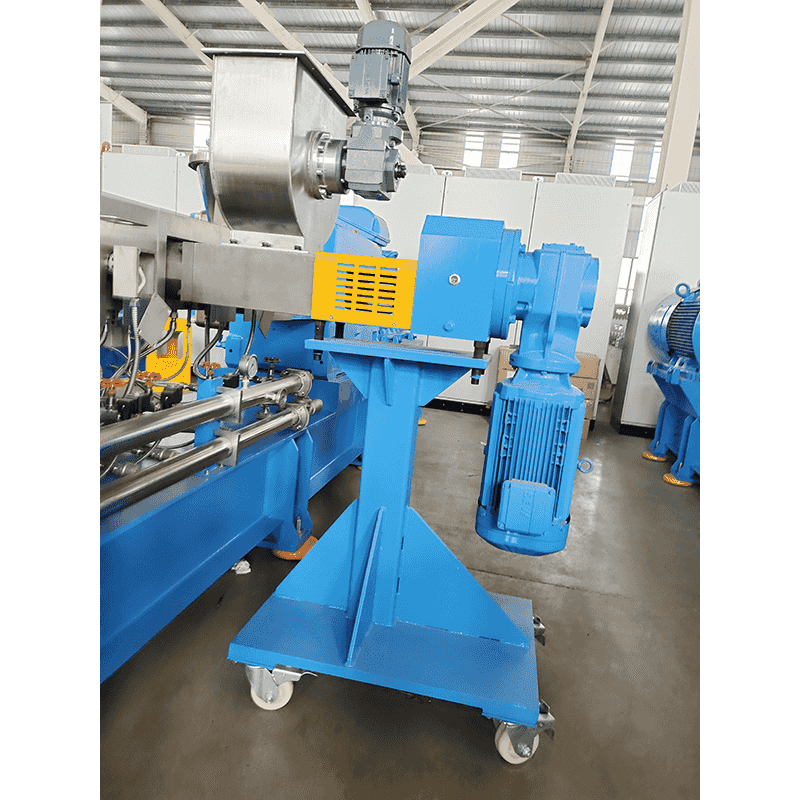 Side Feeder for High-Fill and Powder ProcessingA forced-feed side feeder that handles powders, short fibers, or premix materials. It can use negative-pressure pumping to increase bulk density, improving efficiency when feeding high-fill compounds downstream on twin-screw lines.View Product →
A Practical Implementation Path
Automation does not have to be a one-shot rebuild. A staged path reduces risk and lets operators build confidence with the new controls.
- Characterize every material. Measure bulk density and its variation, particle size, flowability, moisture and temperature limits. Powder behavior decides feeder type, screw geometry and hopper design.
- Define the accuracy target for each ingredient. Derive it from the product specification, not from vendor marketing. A masterbatch color system needs tighter tolerance than a low-cost filler.
- Select the weighing principle and feeder per component. Loss-in-weight for continuous critical dosage, gain-in-weight for batch additions, side feeder for downstream filler.
- Plan control integration. Allocate PLC inputs and outputs, recipe storage, alarm and interlock logic with extruder speed, plus data logging for batch reports.
- Install, calibrate and validate. Run a static weight check, then a dynamic test at minimum and maximum feed rates. A properly tuned loss-in-weight system should hold its rated accuracy across a 10:1 turndown.
- Tune the refill and start-up behavior. Refill level, damping and speed recovery all determine whether accuracy is achieved in production — not only in the acceptance test.
Validation usually reveals two surprises: the real bulk density variation of the incoming material, and the mechanical stiffness needed around the weigh module. Budgeting time for both at the start avoids the most common commissioning delays.
Frequently Asked Questions
A loss-in-weight feeder sits on load cells and continuously measures the weight of the hopper and material. The controller compares the measured weight loss over time with the target feed rate and adjusts screw speed in real time, which delivers gravimetric accuracy even when bulk density changes.
Volumetric dosing measures by volume — screw speed sets the output — so density variation changes the delivered mass. Gravimetric dosing measures by weight using load cells and feedback control, so the delivered mass remains constant. For critical extrusion ingredients, gravimetric is the safer choice.
With loss-in-weight feeding, typical accuracy is ±0.25–0.5% of setpoint under stable conditions. Automatic weight (gain-in-weight) systems usually hold ±0.5–1% of target. Manual bulk weighing commonly lands in the ±2–3% range depending on scale resolution and operator technique.
Yes. Most twin-screw lines can be retrofitted without replacing the extruder. The project typically adds feeders, load cells and a control cabinet, remaps the control logic, introduces HMI recipe management and validates the new dosing accuracy before serial production starts.
At 40–80% filler loading, adding all powder at the main hopper causes poor dispersion and high screw wear. A side feeder introduces the filler downstream into the partially molten polymer, increases the bulk density of the powder by negative pressure action, and improves wetting and throughput.
It removes three error sources: operator technique, scale reading delays and density drift. Recipes and alarms are reproducible, every batch is logged, and the feeder corrects itself continuously — so pellets meet the same target from batch to batch.


