


 ENG
ENG 中文简体
中文简体 русский
 عربى
عربىPlastic masterbatch is the reason a single pellet of resin can deliver the exact color, UV protection, flame retardancy, or anti-static property your product needs. Instead of mixing raw additives directly into the polymer melt at the machine, you dose a pre-compounded concentrate. The result is cleaner handling, better dispersion, and more repeatable quality. But masterbatch is only as good as the equipment that produces it, and that is where twin-screw extrusion technology plays the decisive role.
Content
- 1 What Is Plastic Masterbatch?
- 2 Why Masterbatch Is Preferred: Key Benefits
- 3 Types of Masterbatch
- 4 How Masterbatch Is Produced: The Role of Twin-Screw Extruders
- 5 Choosing the Right Masterbatch Production Line
- 6 Frequently Asked Questions
- 6.1 What is the difference between color masterbatch and additive masterbatch?
- 6.2 How much masterbatch should be added to the base resin?
- 6.3 Can masterbatch be used with recycled plastics?
- 6.4 What causes black specks in masterbatch production?
- 6.5 What is the role of a twin-screw extruder in masterbatch manufacturing?
- 6.6 How to choose a masterbatch production line for high filler content?
What Is Plastic Masterbatch?
A masterbatch is a concentrated mixture of pigments, fillers, or functional additives embedded in a carrier resin. The carrier is chosen to be compatible with the base polymer, so when the masterbatch is let down into the final material, the additives distribute evenly. Common carrier resins include polyethylene, polypropylene, and polystyrene. The active ingredients can be carbon black, titanium dioxide, UV stabilizers, or flame retardants.
The production process always follows the same core sequence: precise dosing, melt compounding in a co-rotating twin-screw extruder, and pelletizing. The resulting concentrate is normally used at a let-down ratio of 1 to 5 percent by weight. That means a small quantity of masterbatch can transform a whole batch of polymer without altering the base material's mechanical profile.
Plastics processors usually buy masterbatch as a ready-to-use pellet. The pellet is fed into the hopper of an injection molding machine or film extruder, along with the base resin. Because the masterbatch is already compounded, the melt sees a uniform distribution of additives. This is in contrast to compounding the same additives on the shop floor, which requires a full compounding line and a quality control lab.
Why Masterbatch Is Preferred: Key Benefits
Choosing masterbatch over raw additives delivers four concrete advantages that directly impact production cost and quality.
- Consistent dispersion: The pre-compounding process breaks down pigment agglomerates, so the final product shows uniform color and properties.
- Cleaner handling: Additive powders are often dusty and hazardous. Masterbatch granules are safe to feed and do not contaminate the work environment.
- Faster changeovers: Dosing a pellet lets you switch colors or properties in minutes, while raw pigment systems require extensive cleaning.
- Better stability: Sensitive additives are protected by the carrier resin, extending shelf life and reducing thermal degradation.
Consider an automotive interior part. If the pigment is not fully destructured, you will see white specks on a black surface. Masterbatch eliminates that risk because the extruder has already done the heavy work of dispersing the pigment.
| Factor | Masterbatch | Raw Additives |
|---|---|---|
| Dosing accuracy | Easy volumetric or gravimetric feeding | Requires precise loss-in-weight feeders |
| Material cleanliness | Low dust, easy to handle | Powder dust, high exposure risk |
| Changeover time | Minutes | Often hours |
Types of Masterbatch
Masterbatches are classified by the function they perform. The most common categories are color masterbatch, additive masterbatch, and filler masterbatch. Each demands a different formulation and, in many cases, a different production line configuration.
- Color masterbatch: Contains pigments such as carbon black, titanium dioxide, or organic colorants. The key challenge is achieving high pigment loading without dispersion failure.
- Additive masterbatch: Carries functional ingredients like UV stabilizers, antioxidants, anti-static agents, or flame retardants. The carrier must match the polymer to avoid migration.
- Filler masterbatch: Used to reduce cost by adding calcium carbonate, talc, or other fillers. These formulations often need high-volume extruders with forced feeding.
Typical let-down ratios vary significantly by type. The chart below shows representative dosing levels used in the industry.
Typical let-down ratios by masterbatch type (approximate)
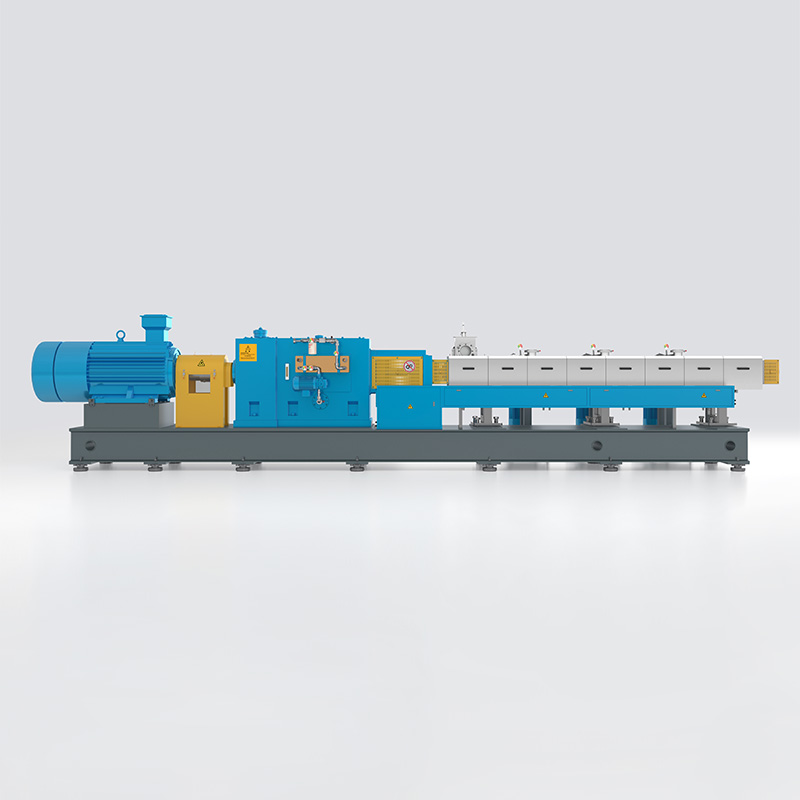 KTS High Performance Twin-Screw Extruder for Engineering PlasticsThis co-rotating twin-screw extruder offers high torque and precise temperature control, ideal for modified engineering plastics and high-viscosity materials, ensuring effective mixing and agglomerate breakdown.View Product →
How Masterbatch Is Produced: The Role of Twin-Screw Extruders
The quality of a masterbatch depends almost entirely on the extrusion step. Co-rotating twin-screw extruders are the standard because they offer high torque, excellent mixing, and precise temperature control. The co-rotating twin-screw principle allows the screw elements to convey the melt while generating the shear needed to break down agglomerates.
A typical masterbatch production line includes a gravimetric feeder, a twin-screw extruder with a specific screw arrangement, a strand or underwater pelletizer, and a vibrating sieve. For color masterbatches, a multi-stage feeding design is often used to add fillers and pigments at different points along the barrel, improving dispersion. This approach is described in the multistage feeding design for precise dispersion.
In a KTS high-performance extruder, the specific torque reaches 14 Nm/cm³, which delivers the shear energy required to destructure titanium dioxide agglomerates without overheating the carrier. This is one reason why high-torque machines are the preferred choice for demanding color masterbatch formulations.
The schematic below illustrates the basic structure of a twin-screw extruder used for masterbatch compounding.
Simplified isometric structure of a co-rotating twin-screw extruder
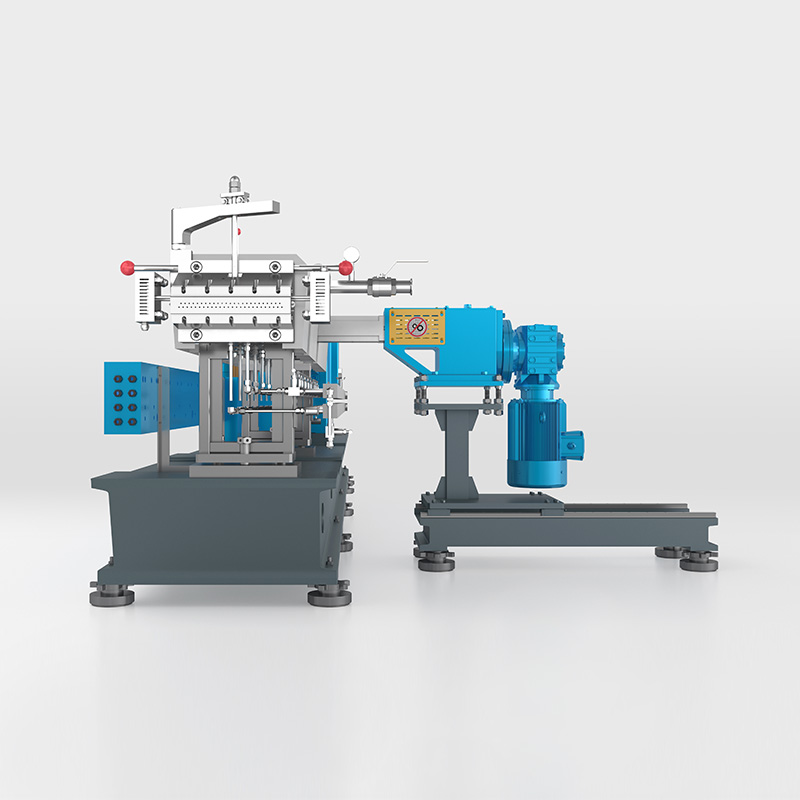 KTD High Volume Twin-Screw Extruder for Filled CompoundsDesigned with deep screw channels and lower specific torque, this extruder suits high filling, reactive, or heat-sensitive materials, providing high volume and gentle processing for filler masterbatch.View Product →
 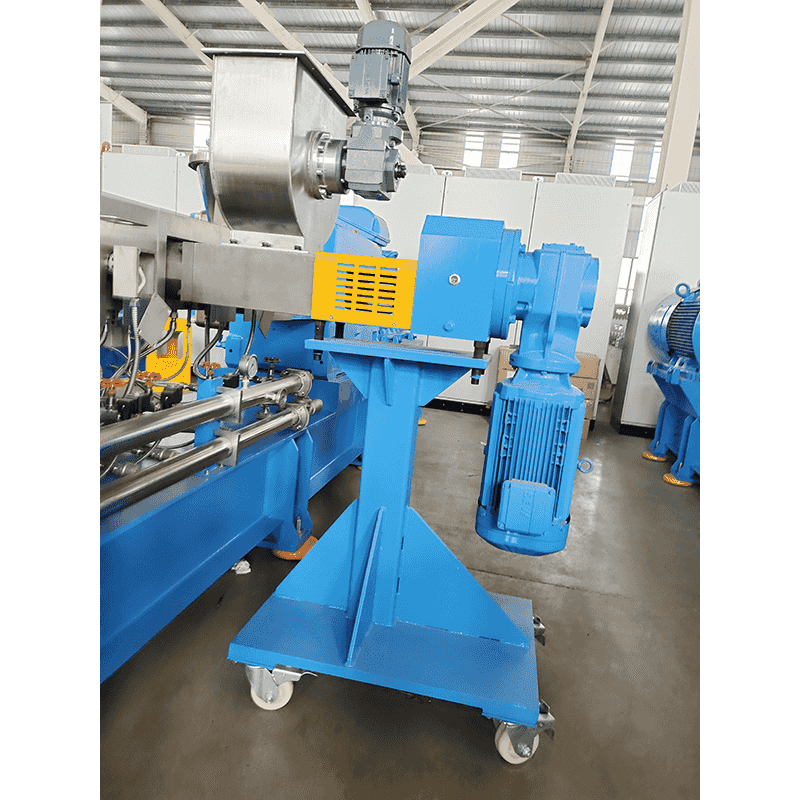 Side Feeder for Powder and Fiber AdditionThis side feeder enables forced feeding of powders, short fibers, or premixes, and can apply negative pressure to increase bulk density, enhancing feeding efficiency in twin-screw extrusion lines.View Product →
Choosing the Right Masterbatch Production Line
Start with the material, not the machine. Filler masterbatch with high calcium carbonate loading demands a high-volume extruder with a robust drive and a side feeder for powder addition. Color masterbatch requires high torque to destructure pigment particles without overheating the carrier. Additive masterbatch with heat-sensitive ingredients needs short residence time and precise zone control.
For general compounding, a KTS high-performance series allows you to run at high screw speeds while maintaining torque. When you need to push throughput for filler-rich formulations, a KTD high-volume series provides the larger free volume needed to accommodate high powder content. The side feeder becomes essential when you need to introduce powders after the polymer has melted, preventing clogging and improving bulk density.
Also think about the pelletizing method. For a filler masterbatch with 60 percent calcium carbonate, underwater pelletizing can handle the abrasive melt, while a water ring hot-face cutting system gives a cleaner product for color masterbatch. The choice affects both pellet quality and downstream handling.
Make your selection using these practical criteria:
- Batch size and required throughput in kg/h
- Maximum filler or pigment loading by weight
- Residence time sensitivity of the additives
- Pelletizing method: strand cutting, water ring, or underwater
- Level of automation for dosing and supervision
Frequently Asked Questions
What is the difference between color masterbatch and additive masterbatch?
Color masterbatch contains pigments or dyes to give the plastic a specific appearance. Additive masterbatch contains functional ingredients like UV stabilizers, anti-stats, or flame retardants to change the plastic’s performance.
How much masterbatch should be added to the base resin?
Typical loading levels range from 1 to 5 percent for color and additive masterbatch, and up to 50 percent for filler masterbatch. Always follow the supplier’s recommendation and verify with a small sample.
Can masterbatch be used with recycled plastics?
Yes. Masterbatch is often used to restore color or improve the properties of recycled materials. Check compatibility between the carrier resin and the recycled polymer matrix.
What causes black specks in masterbatch production?
Black specks are usually caused by degraded polymer residues, poor dispersion of carbon black, or insufficient cleaning during changeover. Proper screw design and regular maintenance reduce this defect.
What is the role of a twin-screw extruder in masterbatch manufacturing?
The extruder melts the carrier, disperses pigments and additives, and pellets the compound. A high-torque co-rotating twin-screw extruder delivers the shear energy needed for uniform dispersion.
How to choose a masterbatch production line for high filler content?
You need a large free-volume extruder, a side feeder for powder addition, and a pelletizing system that handles high mineral loadings. Consider the KTD high-volume series for this application.


