


 ENG
ENG 中文简体
中文简体 русский
 عربى
عربىIf a connector housing has to hold tight tolerances after months in a humid engine bay, or a circulation pump component must survive years of hot water, polyphenylene ether plastic is usually on the engineer's shortlist. Known as PPE — and widely labelled PPO in North America and Japan — this resin earns its place wherever heat, moisture and electrical insulation all push against the same part.
Here is the conclusion up front: PPE is an outstanding engineering thermoplastic, but almost nothing you buy is pure PPE. Virtually every commercial grade is a compounded blend of PPE with polystyrene, fillers and additives, and the twin-screw compounding step — not the base resin alone — decides whether the final pellets actually deliver the datasheet.
Key takeaway: PPE's value is designed in during melt compounding. That makes the extrusion line as important as the resin itself when you evaluate a modified PPE project.
Content
- 1 What Is Polyphenylene Ether Plastic?
- 2 Key Properties That Set PPE Apart
- 3 Where Polyphenylene Ether Plastic Is Used
- 4 Why Pure PPE Is Almost Never Processed Alone
- 5 How Modified PPE Is Made: The Twin-Screw Compounding Step
- 6 Practical Checks Before Specifying a Modified PPE Line
- 7 Frequently Asked Questions
What Is Polyphenylene Ether Plastic?
Polyphenylene ether is an amorphous thermoplastic built from aromatic benzene rings linked by ether bonds, with methyl groups attached to the rings. That rigid aromatic backbone produces its high glass-transition temperature and its natural amber-to-brown colour. Industry references commonly rank it as the fifth-largest general-purpose engineering plastic, alongside the nylon, PC, POM and PBT families.
PPE rarely appears alone in a sales datasheet for one practical reason: the neat resin is extremely difficult to melt-process. Resin makers therefore blend it with polystyrene or impact-modified polystyrene to create modified PPE alloys whose flow, toughness and cost suit injection moulding and extrusion. The two names, PPE and PPO, describe the same resin family — usage simply differs by region and supplier.
One frequently overlooked advantage is density. At a specific gravity of about 1.06 — the lowest among the five major general-purpose engineering plastics, according to a leading PPE producer's technical column — modified PPE helps cut part weight in vehicles and appliances.
Specific gravity of the five major general-purpose engineering plastics (unfilled, typical)
Key Properties That Set PPE Apart
- High heat resistance: neat PPE softens at around 210 °C (published polymer data), and commercial modified grades span heat-deflection temperatures of roughly 90–170 °C depending on the PPE-to-styrenic ratio.
- Dimensional stability: low mould shrinkage and low creep keep tight-tolerance parts stable over long service life.
- Very low water absorption: typically about 0.06% over 24 hours, so mechanical and dielectric properties barely shift in humid conditions.
- Strong electrical insulation: dielectric behaviour stays stable across wide temperature and humidity ranges, which connectors and housings depend on.
- Hydrolysis resistance: unlike polyamides, PPE does not lose strength through water-induced chain scission, supporting fluid-handling and pump duties.
- Flame-retardant tendency: the aromatic structure chars rather than drips, and dedicated FR grades are straightforward to build with standard additive packages.
Typical 24-hour water absorption (%, unfilled grades)
Where Polyphenylene Ether Plastic Is Used
The property set above maps directly onto four large application families:
- Electrical and electronics: connectors, bobbins, relay and junction-box housings, and IT hardware components where insulation and dimensional precision matter more than raw strength.
- Automotive: instrument panels, interior trim, wheel covers, under-hood electrical housings and battery-related parts — the low 1.06 density compounds the weight savings here.
- Fluid handling and filtration: hot-water circulation components, pump housings and filter hardware that exploit hydrolysis resistance.
- Appliances and medical: structural parts for small appliances and select sterilizable device components, often in flame-retardant or high-flow versions.
Why Pure PPE Is Almost Never Processed Alone
Pure PPE has a melt viscosity so high that conventional moulding and extrusion become impractical — which is exactly why modification exists. Blending with polystyrene lowers viscosity and cost, while raising the PPE share raises heat resistance. The usual levers are:
- PPE/PS or PPE/HIPS alloys, where the blend ratio tunes heat-deflection temperature anywhere from about 90 °C to 170 °C.
- Glass-fibre reinforcement, commonly in the 10–30% range, which roughly doubles stiffness and improves creep performance.
- Flame retardants, impact modifiers and heat stabilizers matched to the end application.
Two caveats belong in any honest assessment. First, PPE alloys are attacked by aromatic and chlorinated hydrocarbons, so fuel or solvent contact needs testing. Second, natural UV resistance is limited, so outdoor grades require stabilizers or coatings. Cost sits in the mid-to-upper band of the five major engineering plastics, which is precisely why disciplined blend design matters commercially.
How Modified PPE Is Made: The Twin-Screw Compounding Step
Modified PPE is produced by melt compounding, and the co-rotating twin-screw extruder is the industry-standard machine for it. The process is best read as a sequence of engineered zones:
- Gravimetric feeding of PPE pellets, the styrenic blend partner and additives in exact ratios.
- Melting and distributive mixing, where high torque is essential because PPE-rich melts stay viscous far above the styrenic softening point. Modern line builders address this with machines in the 14 Nm/cm³ specific-torque class — see this overview of what high-torque twin-screw extruders are and why they matter.
- Downstream side feeding of glass fibre or mineral fillers, dosed under negative pressure into the molten pool to protect fibre length and dispersion.
- Vacuum venting to extract moisture and volatiles before the die, so the alloy's low-absorption promise survives into the finished part.
- Die head, cooling and pelletizing, followed by sieving and storage of the final pellets.
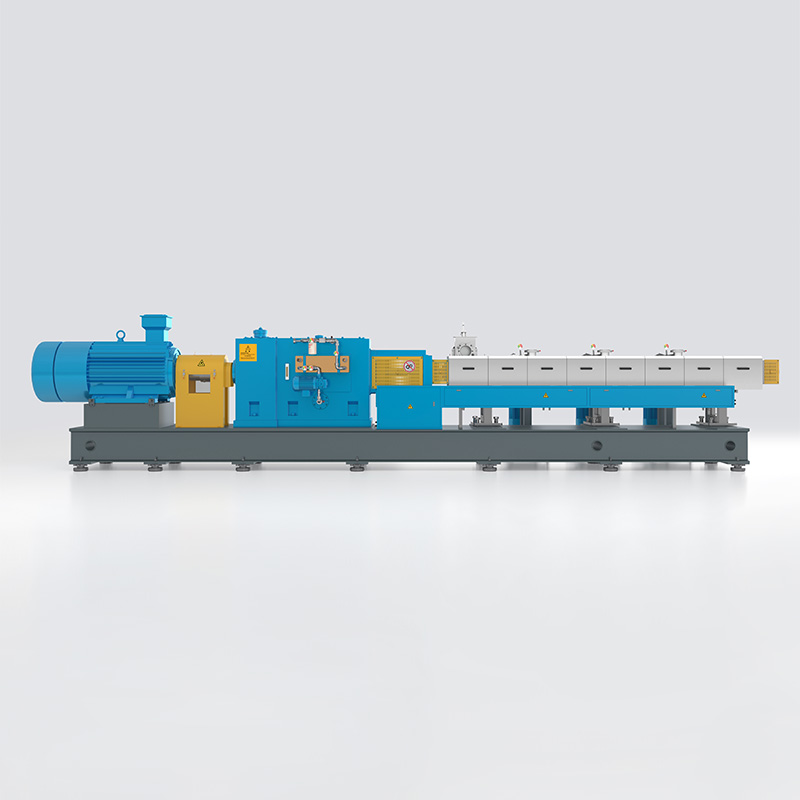 KTS High Performance Twin-Screw Extruder SeriesA co-rotating twin-screw extruder platform with specific torque up to 14 Nm/cm³, sized from lab to large production models. Its high torque keeps the PPE-styrenic viscosity gap controlled during melt compounding, making it a relevant reference point when torque density is the first spec to evaluate.View Product →
Torque density is the first spec to check because PPE-rich formulations punish underpowered drives with rising melt temperature and degraded mechanical properties. A line engineered around a high specific-torque platform keeps the viscosity gap between PPE and the styrenic phase under control, which is what produces a true alloy rather than a layered, poorly dispersed melt.
Filler handling is the second decision point. Glass fibre and mineral fillers are normally introduced partway down the barrel rather than with the main feed, so the polymer is fully molten and the fibres see less breakage.
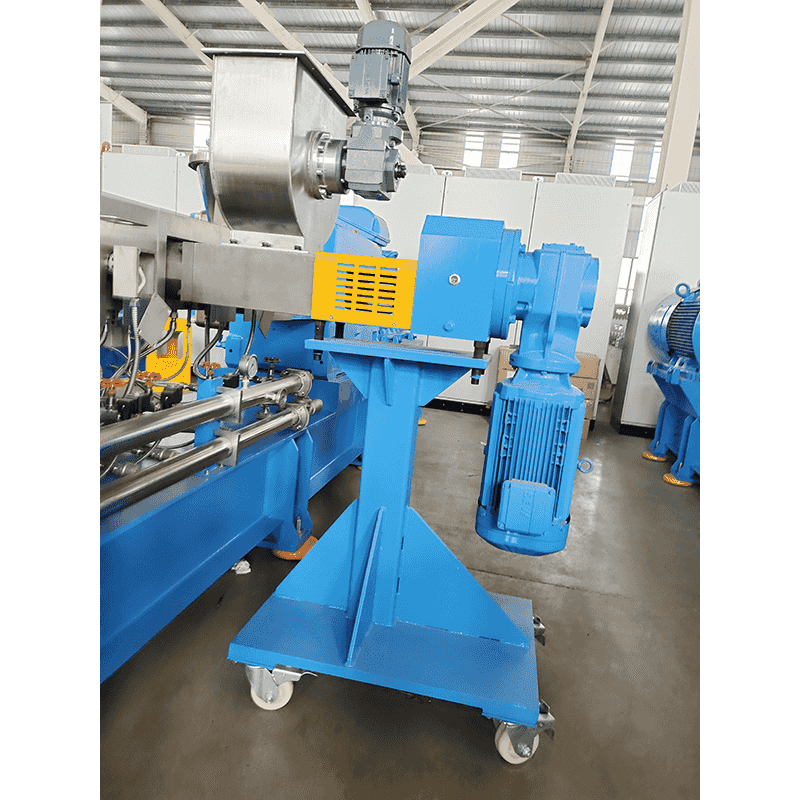 Side Feeder for Twin-Screw Compounding LinesA side feeder for forced feeding of powders, short fibres, or premixes, with optional negative-pressure pumping to raise powder bulk density. It matters here because glass fibre and mineral fillers are typically introduced mid-barrel into fully molten polymer to limit fibre breakage.View Product →
Choosing the Pelletizing Route
The cutting method should follow the grade, not habit:
| Method | How it works | Best suited for | Watch-outs |
|---|---|---|---|
| Strand pelletizing | Strands cool in a water bath or air conveyor, then are cut by rotating knives | Glass-filled and heat-resistant modified PPE grades | Strand breakage with brittle, highly filled melts |
| Underwater pelletizing | Die-face cutting in a closed, water-filled chamber | High-volume, dust-sensitive production | Higher system complexity and start-up procedure |
| Water-ring hot-face cutting | Hot pellets are cut at the die and flung into a rotating water ring | Free-flowing, softer alloy formulations | Less ideal where long glass fibre must be retained |
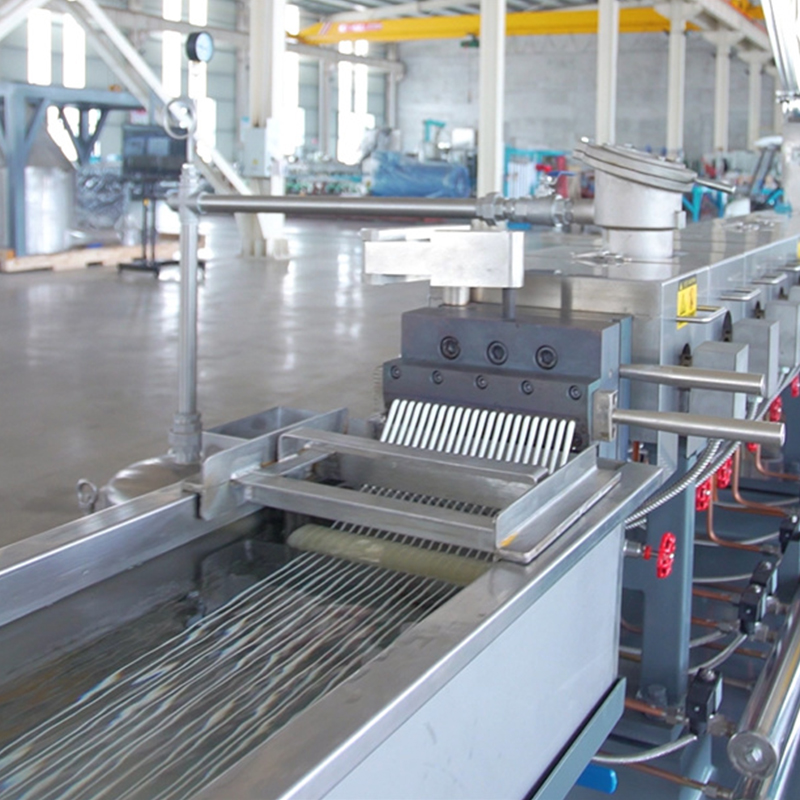 Strand Pelletizing SystemA cutting method that extrudes material as strands, cools them by water, air, or underwater route, then cuts them into pellets. For glass-filled modified PPE it remains the default choice, treating fibres gently and allowing a visible quality check before cutting.View Product →
For glass-filled modified PPE, the strand route remains the default because it treats fibres gently and gives operators a visible quality check before cutting. Sieving and storage complete the chain. The same logic applies to existing assets: an engineering plastic pelletising production line can often be retooled around a new alloy instead of replaced, provided the drive, feeding and vacuum sections are reviewed together.
Practical Checks Before Specifying a Modified PPE Line
- Specific torque and free volume: ask for the machine's Nm/cm³ rating; the high-torque class keeps melt temperature in range with viscous PPE-rich formulations.
- Process length: L/D ratios of roughly 36–48 are common for alloy compounding, leaving room for mixing, side feeding and vacuum zones.
- Feeding accuracy: loss-in-weight feeders hold the PPE/styrenic/filler ratio steady — this ratio is what the datasheet ultimately reflects.
- Devolatilization: at least one strong vacuum zone to hold moisture at the level the electrical specifications assume.
- Pelletizing match: choose the cutting method by filler content and dust tolerance, not by default.
- Cleaning strategy: PPE's high processing temperatures demand a planned purge, and glass-filled work calls for wear-resistant screw and barrel metallurgy.
None of these items is exotic. They are simply the difference between a datasheet and a repeatable production run, and suppliers who engineer the feeding, extrusion, pelletizing and sieving stages as one system make the first ramp-up far more predictable.


